The translation market, the people behind it, and what AI is actually changing
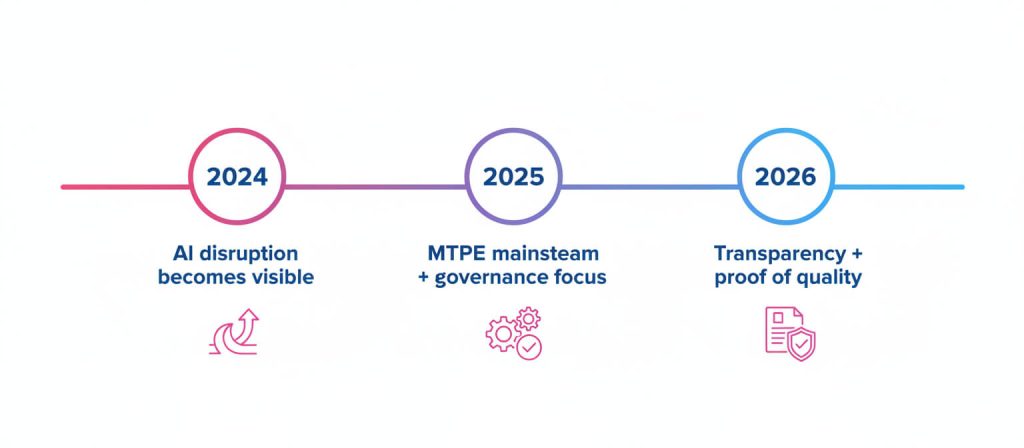
2025 was the year the translation industry stopped debating whether AI would matter and started dealing with how it reshapes pricing, quality, and accountability. The clearest takeaway is that the market didn’t collapse — it re-segmented:
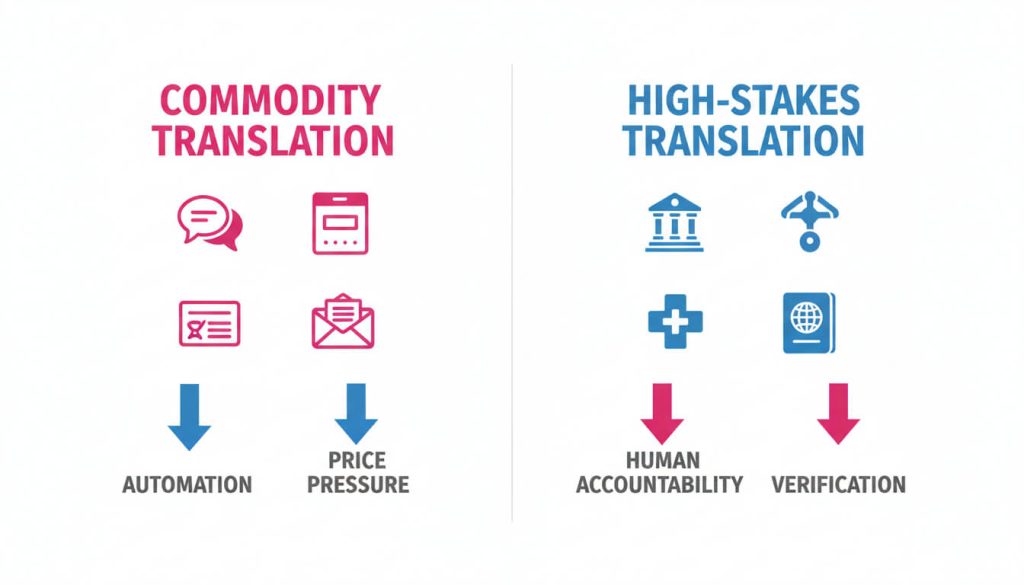
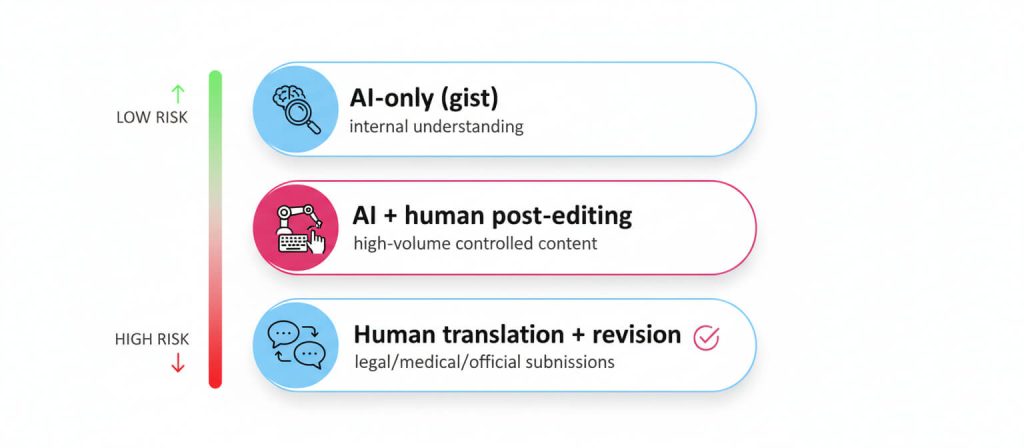
High-volume, low-risk translation accelerated towards automation and post-editing, pulling prices down.
High-stakes translation (immigration, legal, medical, regulated submissions, brand-critical work) became more clearly defined around human responsibility, verification, and data handling — because fluency is not the same as accuracy.
Below is our evidence-based review of what happened in 2025 and what it means for clients and linguists going into 2026.
1) Market snapshot: growth, but with a different shape
The industry is still growing, but expectations have shifted from “fast compounding” to slower, more linear growth as automation changes unit pricing. Nimdzi’s 2025 market estimate puts language services at USD 71.7bn in 2024 with a projection of USD 75.7bn in 2025, while explicitly adjusting long-term growth assumptions downward compared to pre-AI forecasts.
At the same time, buyer-side indicators show more translation volume, not less. Smartling’s 2024 State of Translation findings report volumes up 30% year on year, alongside widespread intent to adopt generative AI.
What this means: demand is resilient, but the value is moving toward providers who can deliver speed plus governance (quality controls, terminology discipline, traceability, confidentiality).
2) Buyer behaviour in 2025: “AI-first” for scale, “human-first” for risk
Across procurement, we saw three dominant buying patterns:
A) “More languages, more often”
AI lowered the perceived cost of expanding languages, which pushed up volume.
B) MTPE became mainstream (and is now a default ask)
Nimdzi reports a big jump in MTPE adoption: in 2024, 62.6% of LSPs had more than 30% of projects as MTPE (up from 29.1% in 2022), and 45.2% used MTPE for at least half of their projects.
C) Official submissions still demand verifiable certification
UK authorities remain clear: if you submit a document not in English or Welsh, you typically need a translation that can be independently verified, including a statement of accuracy, date, translator name/signature, and contact details. That requirement is operationally incompatible with “AI-only” translation because someone must be accountable for correctness.
3) How 2025 felt for translators: pressure, polarisation, and a skills shift
The human impact is real and uneven.
The UK Society of Authors reported in 2024 that 36% of translators had already lost work to generative AI, and 43% said income had decreased in value.
CIOL’s Translators Day 2025 survey found 37% reporting less work, while others reported similar or more — pointing to a split by niche, language pair, and client type.
ITI’s member survey highlights caution at the professional level: 83% not using generative AI in their work, with only 17% incorporating it — contrasting with larger providers investing heavily in AI capability.
What changed in practice: many translators were pushed from “translation” into “correction” (post-editing), often with tighter rates, tighter turnarounds, and more fatigue. The Financial Times captured this shift starkly through translator accounts and the rise of proofreading machine output.
4) Quality in 2025: MT got better, but “looks right” became the problem
AI output is often impressively fluent — and that is exactly where risk increased.
Post-editing is not automatically faster
Nimdzi’s MTPE analysis frames an “efficiency gap” and documents the speed/effort tension as MTPE share rises. In other words: the industry is doing more MTPE, but efficiency gains depend on domain, source quality, and how quality is measured.
Why this matters for clients
Errors in official, legal, medical, and compliance content are not “typos” — they can trigger refusals, delays, or liability. For that category of work, it’s not enough that text is readable; it must be correct, complete, and defensible.
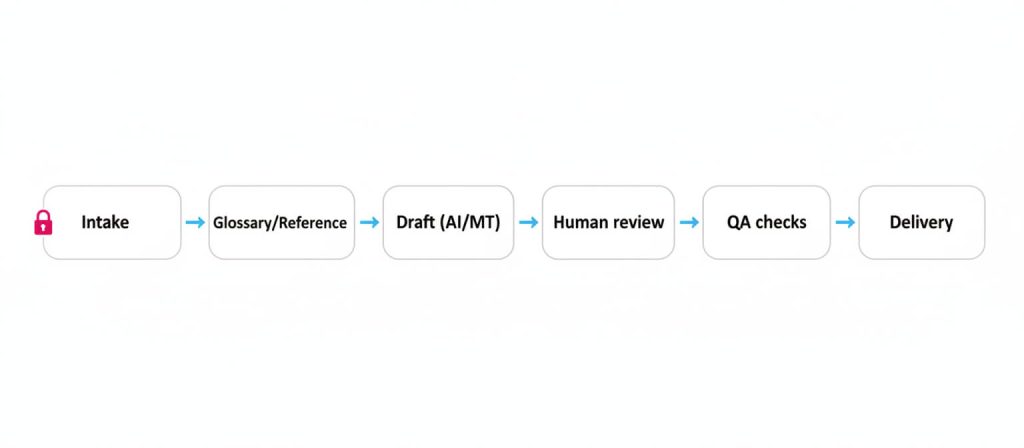
Best-practice response: treat MTPE as a defined service with defined competence requirements — not a vague “quick check”.
5) Standards and what “good” looks like (human and AI-enabled)
Two standards remain central reference points:
ISO 17100:2015 sets requirements for the core processes and resources behind a quality translation service.
ISO 18587:2017 sets requirements for full, human post-editing of MT output and post-editor competence.
Even if a provider isn’t formally certified, these standards are useful as a practical checklist: define scope, assign accountability, ensure appropriate competence, and build QA into the workflow.
6) Regulation and compliance: 2025 brought real rules, not just opinions
EU AI Act: obligations began to bite
The European Commission published guidelines on obligations for general-purpose AI model providers in the run-up to requirements entering application from 2 August 2025 (with later enforcement milestones). Reuters covered the compliance direction of travel: transparency requirements for foundation models, plus evaluation, risk mitigation, and reporting expectations for systemic-risk models.
UK data protection: AI and personal data stayed in the spotlight
The UK ICO’s guidance on AI and data protection remains a key reference point, and the ICO notes it is under review due to legislative changes coming into law in 2025.
Translation has a special privacy profile
Translation routinely includes personal data and “incidental” sensitive details. The EUATC/ATC guidance on GDPR and personal data in translation explains the practical implications and includes risk assessment thinking by content type.
What clients should take from this: if you are translating passports, bank statements, medical letters, contracts, or HR files, you should ask not only “Is it accurate?” but also “Where is the data going, who can access it, and what’s retained?”
7) The pipeline problem: language skills are shrinking
A quiet but critical 2025 development is the decline in formal language learning in the UK. HEPI warns of a “vicious cycle” where low uptake drives university course cuts, worsening skills shortages for employers. This matters because high-quality specialist translation depends on deep language and domain expertise — and that expertise takes years to develop.
8) What this means for 2026: the likely direction of travel
Based on 2025 signals, we expect:
More segmentation by risk Buyers will separate “understanding” translation from “submit to authorities” translation more explicitly.
Transparency becomes non-negotiable Clients will increasingly require disclosure of AI use, data processing locations, and retention policies.
Quality proof beats quality claims Expect more sampling, independent review, and terminology governance — especially in regulated industries.
Human accountability becomes the premium product Not “we used AI”, but “we can stand behind this translation”.
9) What Locate Translate is committing to (and why)
Locate Translate’s position going into 2026 is simple: use technology to improve speed and consistency, but keep humans accountable for the final meaning — especially when documents are used for UK authorities.
For certified translations used with UK bodies, we follow the verifiable certification expectations reflected in UKVI/Home Office guidance (accuracy statement, date, signature, contact details).
For sensitive documents, we emphasise:
confidentiality and controlled handling of personal data, aligned with established GDPR risk thinking for translation content
clear service scoping (human translation vs MTPE vs bilingual review) using standards as reference points
If you’re a buyer, the most useful question you can ask any provider in 2026 is: “Who is responsible for the final text, and what is your process for proving it?”
If you’re asking who pays for legal aid interpreting in London, you’re usually asking one thing: “Will I have to pay out of pocket to understand what’s happening?” In most legally aided situations, the answer is no—but who pays depends on where the interpreting happens and who arranged it.
Here’s the simplest way to think about it:
In court/tribunal hearings: the court service typically arranges and pays for the interpreter for the hearing.
For legally aided solicitor meetings (outside the hearing): the solicitor arranges the interpreter, pays the invoice, then claims it back as a legal aid disbursement.
At a police station interview: the police usually arrange and pay for interpreting for the interview itself.
If you’re a solicitor or caseworker, the key is getting the paperwork and approvals right so reimbursement is smooth. If you’re a client, the key is telling your solicitor early and providing the right language details.
Need an interpreter quickly in London? You can request interpreters for legal matters through our interpreting services team, with clear booking notes and invoice-ready documentation.
The difference between “court interpreting” and “legal aid interpreting”
These two get mixed up all the time—especially in London where hearings, conferences, and client meetings can happen on the same day.
Court interpreting is interpreting that the court or tribunal provides so a party/witness can participate in the hearing.
Legal aid interpreting is interpreting arranged as part of a legally aided case, often for:
solicitor–client conferences
statement taking
instructions before/after hearings
conferences with experts
conferences with counsel
urgent prep meetings (including remote)
Sometimes both are needed:
the court provides the interpreter in the courtroom
the solicitor may need an interpreter outside court to take instructions properly
Who pays for legal aid interpreting in London? A practical decision guide
Use this quick guide to pinpoint who pays.
If the interpreter is needed for a court or tribunal hearing
Most of the time, the court/tribunal arranges and pays for the interpreter for the hearing.
What you should do:
Tell the court/tribunal you need an interpreter as early as possible (or ask your solicitor to do it).
Confirm the language + dialect and any access needs (e.g., BSL, hearing loop, remote option).
If the interpreter is needed for solicitor–client communication (legally aided)
In legally aided matters, the solicitor usually arranges the interpreter, pays the invoice, then claims reimbursement through legal aid as a disbursement—subject to the applicable rules and rates.
What you should do:
Tell your solicitor you need interpreting for meetings and calls (not just the hearing).
Ask the firm to confirm whether they need any pre-approval for the cost.
If the interpreter is needed at the police station
For the interview itself, the police typically arrange and pay the interpreter. If your solicitor needs an interpreter to take instructions outside the formal interview, that may be handled separately (and could fall under legal aid if you qualify).
If the interpreter is needed for other public bodies (Home Office, local authority, NHS)
For official interviews/meetings required by that body, it’s often the responsibility of the organisation requiring attendance to ensure communication access. Your legally aided solicitor may still need a separate interpreter for legal advice and instructions around those meetings.
The London “who pays” table (save this)
Situation in London
Who usually pays?
Who books the interpreter?
What can go wrong if not handled properly?
Court/tribunal hearing (in-hearing)
Court/tribunal
Court staff / listing office
Interpreter booked for hearing only; no coverage for solicitor instructions
Solicitor–client meeting (legally aided)
Solicitor pays, then claims back
Solicitor / caseworker
No prior approval where needed; poor attendance record; rate disputes
Police station interview
Police
Police
Separate interpreter may still be needed for legal advice outside interview
Conference with counsel/expert (legally aided)
Solicitor pays, then claims back
Solicitor
Costs deemed excessive without justification; missing breakdown
Translating key documents in a legally aided case
Solicitor pays, then claims back
Solicitor
Volume not authorised; wrong pricing model; delays in assessment
Legal aid interpreter rates in London (what people actually mean by “rates”)
When people search legal aid interpreter rates or legal aid rates interpreters, they’re usually trying to understand:
whether there’s a standard capped rate, and
what happens if the language is rare or urgent.
In practice, legal aid remuneration uses prescribed rates for interpreters in different categories (civil/family vs criminal), and different London/non-London bands.
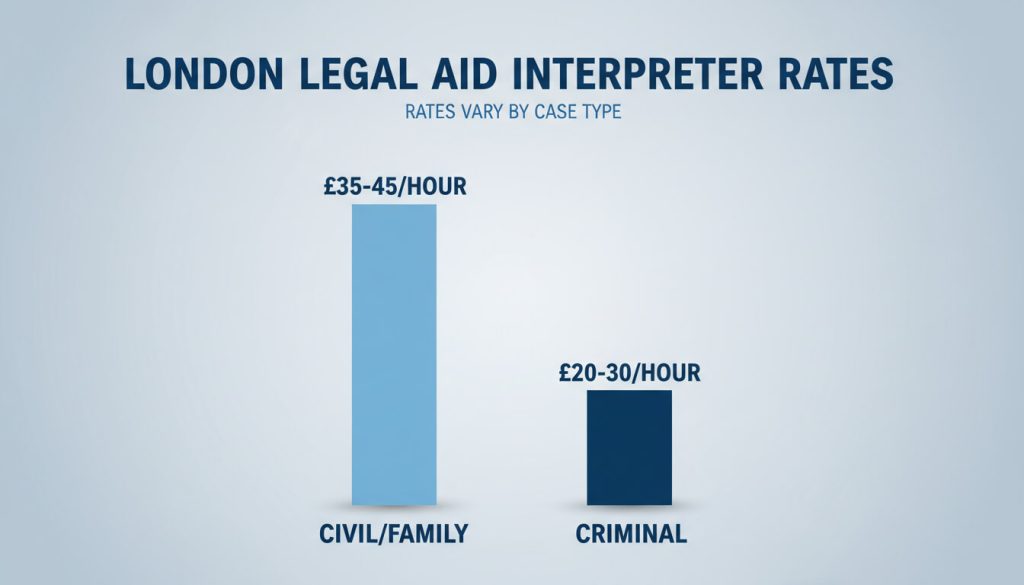
London rate snapshot (commonly applied)
While exact allowances depend on the case type and assessment rules, London is often referenced as:
Civil/family legally aided interpreting in London:£25/hour (typical prescribed maximum)
Criminal legally aided interpreting in London:£29/hour (typical prescribed maximum)
Other cost lines that commonly affect total cost:
waiting time at court (where allowable)
travel time rules (treated differently by case type)
mileage caps
minimum call-out time in some circumstances (needs justification)
Tip for solicitors: if the booking is likely to exceed standard limits (rare language, urgent, multi-hour waiting), plan for the reimbursement path before the interpreter attends.
Need a rate-appropriate quote fast? Upload your details and get a clear, written estimate via our Contact Us page—we’ll include language, dialect, mode, duration, and any travel/waiting assumptions.
“Do I have to pay?” The honest answer (and the exceptions)
If you qualify for legal aid, you usually should not be personally paying for interpreting that is necessary for your representation. But there are a few situations where you might still face costs or delays.
You may have to pay (or be asked to pay) if:
Legal aid isn’t in place yet (no certificate/authority granted and you proceed privately)
the work is outside scope of what’s funded
you insist on using a specific interpreter at a rate that isn’t recoverable
cancellations happen late and the arrangement terms make you liable (this should be agreed clearly up front)
You usually should not pay if:
your solicitor confirms the interpreting is necessary and justified for your legally aided representation
the interpreter is booked through appropriate channels and documentation is maintained
any required pre-approval is obtained in advance
Prior approval and “prior authority” in plain English
This is the number one reason reimbursement gets messy.
Prior authority (or pre-approval) is essentially:
“We’re asking permission to incur this interpreting cost at this level, so it won’t be reduced later.”
It’s commonly needed when:
the language is rare or specialist and market rates exceed the cap
the assignment is urgent/out-of-hours
the booking includes long waiting time, long travel time, or minimum attendance requirements
there are multiple interpreters, multiple sessions, or extended conferences
Practical best practice:
get a written quote with a clear breakdown (hourly rate, minimum time, travel, waiting assumptions)
keep attendance notes signed where possible
record why interpreting was necessary and why alternatives weren’t workable
If you’re a provider firm looking to reduce assessment friction, our team can structure quotes and invoices to support legal aid reimbursement in a clean, auditor-friendly format. See our commitment to quality standards for confidentiality and process controls.
How to request an interpreter for a legally aided case in London
Whether you’re a client or a legal professional, this checklist prevents 90% of problems.
Step 1: Confirm the exact language requirements
Don’t just say “Arabic” or “Kurdish.” Use:
language + dialect (e.g., Levantine Arabic vs Maghrebi Arabic; Sorani vs Kurmanji)
preferred interpreter gender (if relevant)
any safeguarding considerations
any accessibility requirements (e.g., BSL)
Step 2: Choose the mode that fits the risk
Face-to-face: best for statements, sensitive conferences, complex hearings
Remote (video/telephone): often faster for urgent instructions and quick updates
Hybrid: common in London when hearings run late or move lists
For remote hearings or prep, our Zoom interpretation services can support multi-party conferences with clear turn-taking protocols.
Step 3: Provide a “booking brief” (copy/paste template)
Include:
case type (civil/family/crime/tribunal)
venue (court name + address) or remote link
estimated start/end time + whether waiting time is likely
Who pays? Still legal aid route, but you may need pre-approval to avoid reductions.
What matters? Evidence of scarcity and a written quote.
How Locate Translate helps London legal teams keep interpreting simple
When the question is “who pays,” what you’re really trying to avoid is surprise billing and reimbursement delays.
Here’s what we focus on:
clear, written quotes aligned to the matter type
interpreter matching by language, dialect, and legal context
secure handling of sensitive information
invoice-ready documentation to support legal aid claims
fast booking options for London timetables
Client feedback (legal interpreting):
“Our clients needed an interpreter for their complex legal matter… their interpreting service was second to none!” — Jane Wilkinson, Solicitor
If you need legally-focused interpreting or translation support alongside interpreting (statements, evidence, bundles), see our legal translation services.
Ready to book? Send the booking brief via Contact Us and we’ll confirm availability, mode, and a clean estimate.
FAQ
Who pays for legal aid interpreting in London for solicitor meetings?
In most legally aided cases, the solicitor arranges the interpreter, pays the invoice, and then claims the cost back through legal aid as a disbursement—provided the interpreting is necessary and properly documented.
Are legal aid interpreter rates in London fixed?
Legal aid interpreter rates are typically controlled by prescribed maximums that vary by case type. In London, rates commonly referenced include £25/hour for civil/family and £29/hour for criminal, but the recoverable amount depends on the relevant rules and assessment.
Who pays for an interpreter in a London court hearing?
For the hearing itself, the court or tribunal typically arranges and pays for the interpreter so the party or witness can participate. This may not automatically cover private solicitor–client discussions outside the hearing.
Can the Legal Aid Agency refuse to pay interpreting costs?
Yes, if the cost is considered unjustified, excessive, outside scope, or missing supporting records. Where higher-than-standard costs are expected, pre-approval is often the safest route.
Do I have to use a specific interpreter on legal aid?
Usually, your solicitor will book an interpreter who meets the requirements for the case and is available at a recoverable rate. If you insist on a specific interpreter at a higher rate, you may risk unrecoverable costs.
Does legal aid cover translation as well as interpreting?
Often yes, where translation is necessary for the legally aided case. Translation and interpreting are usually treated as disbursements and should be documented and justified like other expert costs.
If you’re dealing with contracts, court hearings, immigration paperwork, or cross-border disputes, the difference between legal interpretation and translation isn’t academic—it’s risk management. One wrong word can change a timeline, a duty, or an outcome.
This guide breaks down what each service does, where each fits, and how to choose the right legal translation and interpreting services for your situation—without wasting time or money.
The short version (and the confusion most people run into)
Most people use “interpretation” to mean “explaining meaning.” In language services, interpreting usually means spoken or signed communication in real time, while translation means written text converted into another language.
But in legal contexts, “legal interpretation” can mean interpretation of legal documents (i.e., clarifying meaning, ambiguity, intent, or how a clause should be understood). That’s why the terms often get mixed up.
Here’s the practical way to keep it straight:
Legal translation → written documents (contracts, pleadings, certificates, policies)
Legal interpreting → live communication (hearings, depositions, meetings, interviews)
Interpretation of legal documents → the meaning-analysis step that must happen before or during accurate legal translation (and sometimes alongside legal advice)
Definitions you can rely on
Legal translation (written)
Legal translation converts written legal content from one language into another while preserving:
meaning and legal effect
defined terms and consistency
formatting, numbering, and references
jurisdiction-sensitive terminology
Common examples:
contracts and agreements
court documents and witness statements
powers of attorney
immigration and civil registry documents
compliance policies, terms & conditions, and corporate filings
If your document needs to be submitted to an authority, you may also need certification, sworn, or notarised formats depending on the country and purpose. (For UK-ready options, see Certified Translations, Sworn Translation Services, and Notarised Translation.)
Legal interpreting (spoken or signed)
Legal interpreting enables two or more parties to communicate across languages in real time—accurately, impartially, and completely.
Common examples:
court hearings and tribunals
solicitor-client meetings
police interviews
mediations and negotiations
remote hearings and multilingual video calls
Interpreting usually happens in one of these modes:
Interpretation of legal documents (meaning, intent, and ambiguity)
This is the “legal meaning” side of the word interpretation: what a clause actually means, how definitions interact, and what ambiguity could imply.
This matters because legal translation is not word substitution—it’s meaning transfer under constraints. A translator must constantly interpret:
whether a term is defined or used generically
whether a phrase has a special legal meaning in a jurisdiction
whether a structure is mandatory (“shall”) or discretionary (“may”)
whether the same word must stay consistent across an entire bundle
whether formatting affects legal function (e.g., schedules, annexes, exhibits)
When the meaning is unclear, a professional workflow flags issues early (before the wrong interpretation becomes a “clean-looking” but legally risky translated document).
Legal interpretation vs legal translation: the differences that actually matter
What matters
Legal interpreting
Legal translation
Medium
Spoken/signed
Written
Speed
Real-time or near real-time
Draft → review → final
Error recovery
Limited (high-pressure)
Higher (can revise)
Output
Spoken message
Deliverable document (often formatted)
Typical pricing
Hour/day/session
Word/page/project (plus formatting/certification)
Typical risk
Miscommunication in live proceedings
Misstated rights/obligations in a document
If you’re deciding quickly: live conversation = interpreter. paperwork = translator. If you have both (common), you likely need both.
When you need legal interpreting—and when you don’t
You need legal interpreting when:
someone must understand and respond in the moment
the stakes are high (court, police, regulatory)
accuracy and impartiality are non-negotiable
the interaction can’t pause for “we’ll translate this later”
You don’t need legal interpreting when:
the communication is purely written
the interaction can wait until a translated document is delivered
the issue is better handled as written bilingual correspondence (less risk than live interpretation)
Tip: If your meeting is about a document and decisions will be made live, the safest approach is often:
translate key documents first, then
interpret the meeting where the documents are discussed
When legal translation is the right tool
Legal translation is essential when a document must be:
filed, submitted, or relied upon as a record
reviewed by lawyers, judges, regulators, HR, or compliance teams
shared across jurisdictions (where wording must be stable and repeatable)
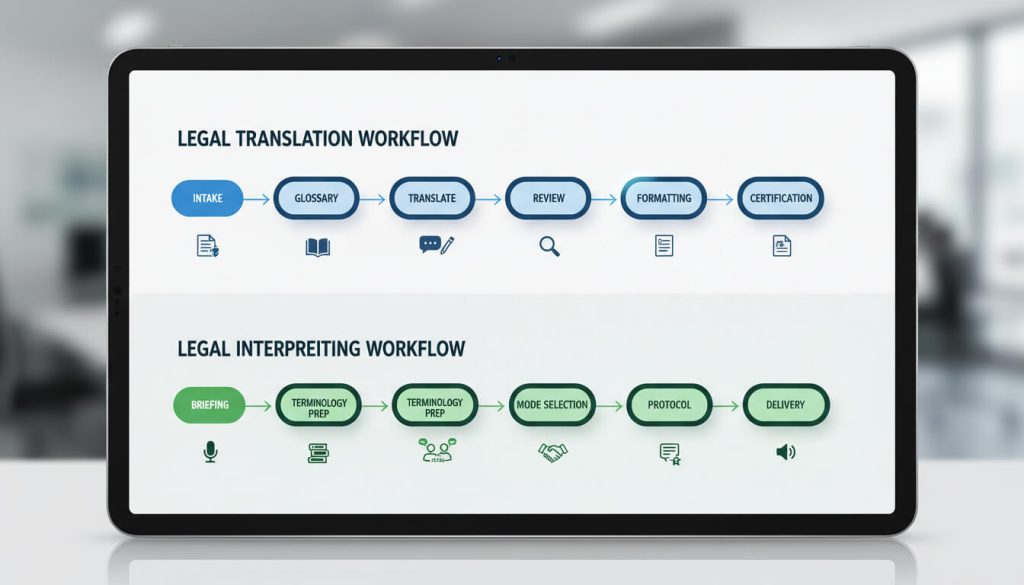
Terminology prep Names, case-specific terms, key facts, and any acronyms.
Mode selection Consecutive vs simultaneous vs whispered; remote vs in-person.
Protocol agreement First-person interpreting, no summarising, request repeats/clarification when needed.
Delivery Impartial, complete, controlled pace.
Debrief (optional) Confirm follow-up needs (e.g., translate exhibits referenced in the hearing).
For remote proceedings and multilingual calls, Zoom Interpretation Services can remove travel delays without sacrificing structure.
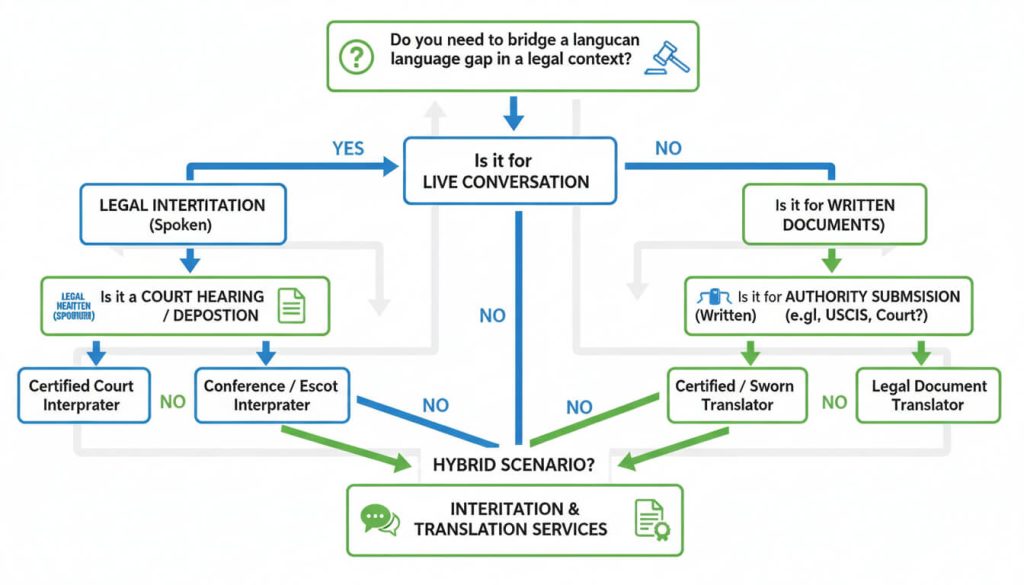
A simple decision guide: which service do you need?
Use this quick checklist:
Is it written? → translation
Is it live conversation (in person/phone/video)? → interpreting
Is a decision being made live based on a document? → translate the document and interpret the meeting
Will the output be submitted to an authority? → translation with the right certification format
Do multiple documents need consistent terms across a bundle? → translation with glossary + QA
If you’re unsure, the fastest way to avoid the wrong choice is to share the document (or agenda) upfront so the right service can be assigned immediately: Contact Us.
The “hidden risk” most competitors don’t talk about: legal system mismatch
Even when two languages share similar legal words, the legal systems behind them may not match perfectly. The danger isn’t grammar—it’s false equivalence:
a term in one jurisdiction may not exist in the other
a title or court role may differ in authority or scope
“standard” clauses may carry different practical implications
That’s why quality legal work often includes:
careful term selection with context
consistent handling of defined terms
flags for ambiguity (instead of silently guessing)
Common mistakes (and how to avoid them)
Mistake 1: Using a general translator for legal content
Legal texts rely on precision, consistency, and jurisdiction-aware phrasing.
Avoid it by: choosing a provider that matches legal linguists to legal matters (not just language pairs).
Mistake 2: Treating interpreting like “summarising”
In legal settings, “close enough” can become a serious procedural problem.
Avoid it by: confirming professional protocol in advance: first-person delivery, completeness, and permission to ask for repeats.
Mistake 3: Ignoring formatting and cross-references
Court bundles and contract annexes break easily if numbering, exhibits, or references drift.
Avoid it by: ensuring QA checks include names, dates, figures, clause references, and pagination integrity.
Mistake 4: Translating without clarifying ambiguous source text
If the source clause is unclear, a “clean” translation can lock in the wrong meaning.
Avoid it by: using a workflow that flags ambiguities early and requests clarification.
Mini case insights: what “right” looks like in the real world
Case 1: Cross-border contract negotiation
Need: translate the draft agreement for review, then interpret negotiation calls
Risk: inconsistent defined terms (“Services,” “Deliverables,” “Confidential Information”)
Best practice: glossary-first translation + interpreted negotiation with the glossary available live
Case 2: Court-related communication
Need: interpreting for hearings, plus translation of exhibits/witness statements
Risk: time pressure + high consequences
Best practice: schedule interpreting early, translate key documents in priority order (starting with anything the court will rely on)
Working with Locate Translate for legal interpretation and translation
When stakes are high, you want a process that’s built for legal reality: deadlines, accuracy, consistency, and confidentiality.
“Our clients needed an interpreter for their complex legal matter… second to none.” — Jane Wilkinson, Solicitor
Whether you need submission-ready documents or real-time support in meetings and hearings, start by sharing what you have. The fastest route is to upload your document and request a quote here: Contact Us
FAQ Section
What is the difference between legal interpretation and translation?
Legal interpretation typically refers to real-time spoken communication (legal interpreting), while legal translation converts written legal documents into another language. “Interpretation of legal documents” can also mean clarifying a clause’s meaning before translating.
Can an interpreter translate legal documents?
Not as a substitute for legal translation. Interpreting is for live spoken/signed communication; legal translation is for written documents that often require formatting, consistency, and review.
When do I need legal translation and interpreting services together?
You need both when a document must be translated for review or filing and the matter involves live conversations—such as contract negotiations, depositions, hearings, or solicitor-client meetings.
What does “interpretation of legal documents” mean in translation projects?
It’s the meaning-analysis step: identifying defined terms, resolving ambiguity, and mapping legal concepts between jurisdictions so the translated document preserves legal intent and effect.
Are certified translations required for legal documents?
Sometimes. If the translated document is being submitted to an authority (immigration, courts, universities, government bodies), certification or specific packaging may be required. Requirements vary by country and purpose.
Is remote legal interpreting reliable for hearings and meetings?
It can be, especially when the process includes preparation, terminology briefing, and the right interpreting mode. Remote options are commonly used for multilingual video calls and time-sensitive matters.
Legal interpreting is the spoken (or signed) transfer of meaning between languages in legal situations—accurately, impartially, and in a way that preserves the tone, register, and intent of what’s being said. It can take place in a courtroom, a police station, a solicitor’s office, an immigration tribunal, a prison visit, or a remote video hearing.
If you’re here because you’re asking “what is legal interpreting?”, you’re likely dealing with a high-stakes conversation where a misunderstanding could affect rights, outcomes, or safety. This guide explains what legal interpreting covers, how it works in real life, what “good” looks like, and how to book the right support.
Need an interpreter for a legal matter? Request a legal interpreting quote from Locate Translate and we’ll match you with an interpreter suited to your language pair, setting, and urgency.
Legal interpreting in one sentence
Legal interpreting is professional interpreting in legal settings where accuracy, confidentiality, and impartiality are essential—often with specialist legal terminology and strict protocols.
Where legal interpreting is used
Legal interpreting services can be required anywhere legal rights, formal procedures, or evidence are involved. Common settings include:
Police and law enforcement
Interviews under caution
Statement taking
Arrest, detention, custody processes
Courts and tribunals
Magistrates’ Court, Crown Court, County Court
Family proceedings
Immigration and asylum hearings
Employment tribunals and other specialist tribunals
Solicitors and barristers
Client consultations
Taking instructions
Conferences with counsel
Preparing witness evidence
Prisons and probation
Legal visits
Risk assessments and formal meetings
Alternative dispute resolution
Mediation and arbitration
Remote proceedings
Video hearings
Telephone conferences and urgent advice calls
A helpful rule of thumb: if the interaction can lead to a formal record, a decision, or legal consequences, you should treat it as legal interpreting—not general interpreting.
What a legal interpreter actually does
A legal interpreter’s job isn’t to “help the conversation along” or “make it easier.” Their job is to transfer meaning faithfully.
That means:
Rendering speech accurately and completely (including hesitations, corrections, and emotionally charged language)
Preserving register (formal, informal, technical, or colloquial)
Maintaining impartiality (no advising, coaching, or summarising)
Managing turn-taking so nothing is missed
Flagging clarity issues (for example: “The speaker used an idiom that doesn’t have a direct equivalent—interpreter will interpret the meaning.”)
In legal work, “close enough” isn’t close enough. A single word can change legal meaning, intent, or credibility.
Legal interpreting vs legal translation
People often confuse these—and it matters.
Legal interpreting
Spoken/signed language
Happens in real time
Used for hearings, interviews, meetings, calls
Legal translation
Written text
Produced as a document
Used for contracts, witness statements, court orders, evidence bundles, certificates, formal correspondence
Sometimes both are needed. For example, an interpreter may provide sight translation (reading a document aloud in another language) during a meeting, but that does not replace a properly prepared written translation when a document must be filed or relied upon.
If you’re unsure which you need, the safest approach is to describe the setting and what will happen, and we’ll advise whether interpreting, legal translation, or both is appropriate.
The three core modes of interpreting in legal settings
Consecutive interpreting (most common)
The speaker talks for a short segment, then pauses while the interpreter renders it into the other language.
Where it’s used: solicitor conferences, police interviews, witness preparation, many court interactions.
Why it’s used: it’s controlled, precise, and allows full rendering of information.
Simultaneous interpreting
The interpreter renders speech in real time while the speaker continues (often with specialised equipment, or by whispering/chuchotage in limited contexts).
Where it’s used: longer hearings, fast-paced proceedings, multi-party sessions, conferences.
Why it’s used: it saves time, but it demands strong concentration and a suitably qualified interpreter.
Sight translation (common, but often misunderstood)
The interpreter reads a written document and interprets it orally into the other language.
Where it’s used: showing a client a charge sheet, bail conditions, a consent order, a letter before action, or a tribunal document during a meeting.
Important: sight translation is not a substitute for a written translated document when you need a filed, certified, or complete written translation.
What makes legal interpreting different from other interpreting?
Legal interpreting services are different because the interpreter must handle:
Specialist legal terminology (and different legal systems)
High evidential stakes (what’s said can be recorded, quoted, challenged)
Strict ethics (impartiality, confidentiality, professional boundaries)
Procedural language (formal courtroom phrasing, warnings, cautions)
Power imbalances (a vulnerable person vs institutions)
Rapid shifts in register (technical terms one moment, slang the next)
In everyday interpreting, a small “tidy-up” might not matter. In legal interpreting, it can.
Examples: what legal interpreting looks like in real life
Example 1: Police interview
A suspect is interviewed under caution. The interpreter must render:
the caution wording precisely,
every question and answer fully,
any slang or ambiguous wording faithfully (without “fixing it”).
Why it matters: misrendering a key phrase can affect intent, admissions, and fairness.
Example 2: Solicitor-client conference
A solicitor takes instructions for a civil claim. The client explains dates, events, names, and documents. The interpreter must keep the pace manageable and ensure:
numbers, dates, and proper nouns are accurate,
the solicitor’s advice is rendered without simplification,
the client’s tone and certainty are preserved.
Why it matters: inaccurate detail now becomes expensive later.
Example 3: Court hearing (fast-moving)
A judge makes directions: filing deadlines, disclosure steps, adjournments, costs. The interpreter may work simultaneously for parts of the hearing and consecutively when the client needs to speak.
Why it matters: missed directions can lead to procedural penalties.
Example 4: Family proceedings (high emotion)
A parent gives evidence. Emotion, interruptions, and sensitive content require the interpreter to be steady, neutral, and exact.
Why it matters: credibility and safeguarding decisions may depend on precise testimony.
Example 5: Immigration/asylum hearing
Questions can be detailed and culturally sensitive. The interpreter must avoid “normalising” language and must render uncertainty, pauses, and corrections as they happen.
Why it matters: small differences can be interpreted as inconsistencies.
Legal terminology for interpreters (a practical mini-glossary)
Legal interpreting often involves terms that have no perfect one-word match between legal systems. Good interpreting doesn’t “force” equivalence—it conveys meaning with the right legal function.
Here are examples of terms that frequently appear, with the kind of meaning an interpreter must preserve:
Term (English)
What it generally refers to
Interpreting note
Adjournment
Hearing moved to another date
Preserve whether it’s postponed vs temporarily paused
Bail
Release with conditions
Don’t confuse with “bond” or informal “deposit” wording
Custody
Detention by police/prison
Context matters: police custody vs child custody
Disclosure
Exchange of evidence/documents
Not “revealing secrets”—it’s a procedural duty
Injunction
Court order to do/not do something
Often needs functional explanation in some languages
Plea
Guilty/not guilty response
Not a “request” in the everyday sense
Witness statement
Written evidence
May also require written legal translation separately
Sentence
Court-imposed penalty
Not “a phrase” (language meaning)
If you’re organising interpreting in legal settings, sharing key case terms and documents in advance (where permitted) helps the interpreter prepare and reduces risk.
What “good” legal interpreting sounds like (and red flags to watch for)
Signs you have the right interpreter
Speaks in first person (“I was there…”) rather than “He says he was there…”
Interprets everything, not just the “main points”
Maintains neutral tone, even in emotional situations
Clarifies ambiguity appropriately (without taking over the conversation)
Handles numbers, dates, names carefully
Manages turn-taking politely so accuracy is protected
Red flags
Summarising or “explaining” instead of interpreting
Giving advice to the client or “helping them answer”
Skipping repetitions, hesitations, or corrections
Changing the level of formality (“softening” or “strengthening” language)
“Tidying up” grammar in a way that changes meaning
In legal contexts, these aren’t minor style issues—they can affect the integrity of the record.
Confidentiality, impartiality, and professional boundaries
Legal interpreting services typically operate under strict expectations:
Confidentiality: what’s discussed stays private, subject to legal obligations.
Impartiality: the interpreter is not on anyone’s “side.”
Accuracy and completeness: no additions, omissions, or substitutions.
Professional boundaries: the interpreter does not fill in forms, negotiate outcomes, or advocate.
This is also why using a friend, family member, or bilingual staff member is usually a poor idea for legal situations—especially where the conversation is recorded, contested, or emotionally charged.
Remote legal interpreting: video and telephone
Remote hearings and urgent calls are now common. Remote legal interpreting can work very well when it’s set up properly:
Best practice for remote sessions
Use stable audio and a quiet, private environment
Confirm who is present and the interpreter’s role at the start
Speak in short segments and avoid talking over each other
Ensure the interpreter can see/hear every speaker clearly
Plan for breaks in longer hearings (fatigue affects accuracy)
If you need remote legal interpreting quickly, request a quote with the language, time zone, platform (if known), and whether it’s court, police, or solicitor work.
How to book the right legal interpreting service (a simple checklist)
When you’re arranging interpreting in legal settings, the aim is to reduce risk. A good booking process covers:
Language and dialect (and whether a regional dialect is essential)
Topic and documents (charges, orders, pleadings, evidence types)
Duration and urgency (including potential overruns)
Security and privacy needs (especially for remote sessions)
Qualifications and experience
legal interpreting experience
recognised professional credentials where appropriate
Conflicts of interest (particularly in small communities)
Ready to book? Send the basics and we’ll come back with an interpreter match and a clear quote.
Who needs legal interpreting most often?
Legal interpreting is commonly needed by:
Solicitors and law firms handling multi-language clients
Barristers’ clerks arranging conferences and hearings
Businesses in disputes, employment matters, or compliance investigations
Individuals attending court, tribunal, or police interviews
Public sector and third-sector organisations supporting vulnerable people
If your situation involves formal rights, official decisions, or recorded statements, it’s worth treating interpreting as a professional safeguarding measure—not a convenience.
What affects the cost of legal interpreting?
Pricing for legal interpreting services typically depends on:
Language rarity and interpreter availability
Setting (court/police vs office meeting vs remote)
Duration and whether waiting time is expected
Mode (simultaneous can require additional resources)
Location, travel, and security procedures (if on-site)
The most cost-effective choice is usually the one that prevents delays, adjournments, and rework.
A practical takeaway: the “record test”
If you’re still asking what is legal interpreting in practical terms, use this test:
If you would be uncomfortable relying on an imperfect summary in the official record, you need legal interpreting—not informal bilingual help.
Work with interpreters who understand legal context
At Locate Translate, we support legal interpreting across common legal settings, with interpreters selected for the right combination of language, experience, and professional conduct expectations.
Request a legal interpreting quote today and tell us:
language and dialect,
setting and date/time,
whether it’s remote or in-person,
and any documents or key terms (where permissible).
FAQ Section
What is legal interpreting in simple terms?
Legal interpreting is professional spoken or signed language interpreting used in legal situations—such as courts, police interviews, tribunals, and solicitor meetings—where accuracy and neutrality are essential.
When do I need legal interpreting services instead of general interpreting?
You typically need legal interpreting services when a conversation affects legal rights, formal decisions, evidence, or official records—especially in court, police, immigration, family proceedings, or legal advice meetings.
What’s the difference between legal interpreting and legal translation?
Legal interpreting is spoken/signed communication in real time. Legal translation is written text converted into another language as a document. Some matters require both (for example, a meeting plus translated documents for filing).
Can a bilingual friend or family member interpret for court or the police?
It’s strongly discouraged in most legal contexts. Legal interpreting requires impartiality, accuracy, confidentiality, and the ability to handle legal terminology and formal procedure without influencing outcomes.
What qualifications should a legal interpreter have?
Qualifications and expectations vary by setting, but you should look for proven experience in interpreting in legal settings and recognised professional credentials appropriate to the assignment, especially where formal proceedings are involved.
Is remote legal interpreting reliable?
Yes—when set up properly. Clear audio, good turn-taking, privacy, and the right interpreting mode make a significant difference, particularly for fast-moving hearings or complex evidence.
Access to justice relies heavily on accurate, impartial interpreting. For solicitors, caseworkers, and public bodies working under Legal Aid, understanding current interpreter rates—and how they are applied—is essential. This guide provides the most up-to-date overview of legal aid interpreter rates in the UK, who pays, what’s covered, and how to ensure compliance, while giving you practical insights gathered from real-world legal workflows.
At Locate Translate, we support law firms, courts, and government bodies every day with qualified, DPSI-level interpreters and legally compliant rates. Below you’ll find everything you need to navigate the system with clarity.
Legal Aid Interpreter Rates in the UK: The Current Fee Structure
How Legal Aid Interpreter Rates Are Set
Legal aid interpreter rates in the UK are based on hourly fees set by the Legal Aid Agency (LAA). The exact rate depends on:
The location of the assignment
The interpreter’s qualification level
Whether the booking is face-to-face, remote, or urgent
The duration and nature of the legal proceedings
Rates are geared toward ensuring interpreters are adequately compensated while keeping costs manageable for publicly funded cases.
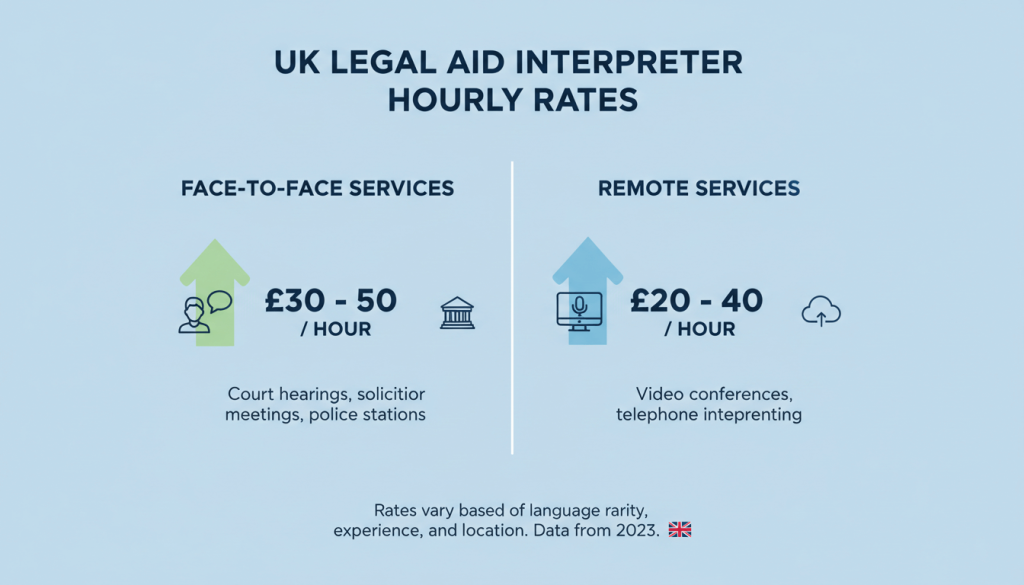
Standard Legal Aid Interpreter Hourly Rates (Typical Ranges)
These ranges reflect current industry-standard fees recognised across UK legal settings.
Face-to-Face Interpreting (Most Common)
Qualified (DPSI / NRPSI): £28–£34 per hour
Advanced / Specialist (Police, Mental Health, Immigration): £34–£42 per hour
Minimum booking: Usually 2 hours + travel
Remote Interpreting (Telephone or Video)
Qualified interpreters: £22–£28 per hour
Short-notice or out-of-hours: £30–£38 per hour
Minimum booking: Often 1 hour
Travel Time & Expenses
Paid at approved LAA travel rates
Mileage, public transport, and parking claimable with receipts
Travel time often paid at a reduced hourly rate
Document Translation Under Legal Aid
While not always listed beside interpreting fees, translation rates are also applicable:
Standard translation: £18–£28 per 1000 words
Specialised legal/medical translation: £30–£42 per 1000 words
Urgent turnaround: Higher rates may apply
If you need guaranteed LAA-compliant quoting for translation or interpreting, Locate Translate provides written estimates accepted by solicitors and caseworkers.
Who Pays for Legal Aid Interpreting in the UK?
Legal aid typically covers interpreting costs in the following situations:
1. Solicitor Firms Handling Legal Aid Cases
Solicitors submit interpreter invoices as part of their legal aid claim, and the LAA reimburses the costs.
2. Courts and Tribunals
HMCTS covers interpreter fees for court-ordered interpreting.
3. Police Stations (PACE Interpreting)
Police forces pay for interpreters in custody or investigative contexts, including:
Arrest interviews
Charge advice
Witness statements
4. Immigration & Asylum Cases
Interpreting for asylum interviews, appeals, and Home Office submissions may be covered depending on legal aid eligibility.
In London: legal aid interpreter rates generally follow the same national structure, though higher travel expenses or minimum bookings are common due to location.
Factors that Affect the Total Cost
Even under legal aid, overall cost varies based on:
Interpreter Qualification Level
LAA-approved qualifications include:
DPSI (Law)
NRPSI registration
Community interpreting at Level 6 for some contexts
Urgency
Same-day or evening appointments may incur higher rates.
Language Rarity
Common languages (Polish, Urdu, Arabic) follow standard rates. Rarer languages (Tigrinya, Pashto, Amharic, Karen) may carry higher fees due to limited interpreter availability.
Session Length
Longer hearings reduce effective hourly cost because minimum fees apply only once.
Practical Examples from Real Legal Settings
Case Example 1 – London Immigration Appeal
Language: Albanian
Duration: 3-hour tribunal session
Interpreter Qualification: DPSI
Total: £102 + travel
Case Example 2 – Police Station (PACE) Interview
Language: Mandarin
Duration: 1.5 hours
Mode: Telephone interpreting
Total: £45
Case Example 3 – Translation for Evidence Bundle
12,000-word evidence pack
Language: Arabic
Certified translation
Total: £360
These examples help solicitors predict budgets and prepare accurate estimates for LAA submissions.
Why Legal Professionals Choose Locate Translate
Because legal proceedings demand accuracy and reliability, our interpreting services include:
Qualified interpreters with specialist legal backgrounds
Rapid response for urgent or same-day bookings
Guaranteed LAA-compliant pricing
Multi-lingual support across 30+ sectors
Court-ready, certified translations
“We rely on Locate Translate for all our legal aid language needs. Fast, reliable, and consistently approved by the LAA.” — Partner, London Immigration Practice
If you need an interpreter for a legal aid case, you can request an immediate quote below.
Request a Free Consultation Today — Fast, LAA-Compliant Interpreter Support
FAQs About Legal Aid Interpreter Rates
1. What are the current legal aid interpreter rates in the UK?
Most legal aid interpreters charge £28–£34 per hour for face-to-face interpreting and £22–£28 per hour for remote sessions, depending on qualification and location.
2. Who pays for a legal aid interpreter?
The Legal Aid Agency reimburses solicitors for interpreter fees as part of the legal aid claim. Courts and police forces also cover interpreting when arranged through their channels.
3. Are legal aid interpreter rates higher in London?
Interpreter fees are similar nationwide, but additional travel charges or higher minimum booking times are common in London due to travel and availability factors.
4. Do legal aid rates cover document translation as well?
Yes, legal aid can cover translation fees for evidence bundles, client statements, medical records, and tribunal documents, usually charged per 1000 words.
5. What qualifications must a legal aid interpreter have?
DPSI or NRPSI registration is standard. Some cases accept Level 6 community interpreting, depending on complexity.
6. How do I book an interpreter under legal aid?
You simply provide the case details, location, language, and your legal aid reference. Locate Translate provides a compliant quote and assigns a qualified interpreter immediately.