
If you’re searching for international stamped translation, you’re probably holding a deadline in one hand and a document in the other—visa, marriage, degree, court paperwork, company documents—wondering one simple thing:
Will a “stamped translation” be accepted abroad, or will it get rejected at the counter?
Here’s the truth: a stamp isn’t a universal passport. A stamp only works if it matches what the receiving authority (embassy, immigration office, court, university, registrar, ministry) considers valid. In some countries, a translator’s stamp is enough. In others, you’ll need a sworn translation, a notarised translation, or legalisation (apostille / embassy legalisation).
This guide breaks it down clearly—so you can choose the right format the first time and avoid delays.
If you want us to confirm what your destination authority needs, you can upload your file and message the country/authority and deadline here: Contact Locate Translate.
The 30-second answer (what most people actually need)
A stamped translation is accepted internationally only when the receiving authority accepts that type of stamp.
Most international cases fall into one of these three outcomes:
- Certified translation (translation + certification statement + signature + contact details; often stamped by the translator/agency)
→ Common for UK use and many international submissions that simply require proof the translation is accurate.
Get it here: Certified translation services - Sworn translation (translation produced by a court-appointed / officially authorised translator in the destination country’s system)
→ Common across many civil-law jurisdictions where “sworn” status is a formal legal category.
Explore: Sworn translation services - Notarised + legalised/apostilled (translation certified, then notarised, then apostilled or embassy-legalised)
→ Common when a foreign ministry/embassy wants a chain of authentication, especially for high-stakes civil status and business documents.
Start here: Notarised translation services and Apostille services
If you’re unsure which bucket you’re in, send the destination country + receiving authority name (example: “Spanish Consulate in London”, “German court”, “UAE MOFA”, “University admissions office”) and we’ll advise the safest format: Embassy certified translation.
What does “stamped translation” actually mean?
People use “stamped translation” to describe different things—so misunderstandings are common.
A “stamp” could mean:
- Translator/agency stamp: a professional stamp placed on the translated pages (often alongside a certification statement).
- Notary stamp: a notary public verifies the identity/signature of the translator (or the person making a declaration).
- Apostille: a government legalisation certificate that authenticates the signature/seal on a document for international recognition between participating countries.
- Embassy/consular stamp: some processes require embassy legalisation (a consulate confirms authenticity after earlier steps).
- Sworn translator seal: an official seal used by a sworn/authorised translator in a country where sworn translation is regulated.
So when someone says, “I need an embassy translation stamp,” what they might actually need is:
- a certified translation for embassy submission, or
- a notarised translation, or
- an apostilled translation, or
- a sworn translation—depending on the embassy and the purpose.
If your request specifically mentions embassy translation stamp or “foreign authority translation,” don’t guess. A mismatch usually means rejection.
Why international acceptance varies so much
International document acceptance isn’t just about language. It’s about legal responsibility.
Authorities care about:
- Who is legally accountable for the translation’s accuracy
- How the translator’s identity can be verified
- Whether the document has been authenticated for cross-border use
- Whether the destination country has a sworn/authorised translator system
- Whether your document needs legalisation (apostille or consular legalisation)
That’s why “stamped translation accepted internationally” has no one-size-fits-all answer.
The three “levels” of international stamped translation (simple framework)
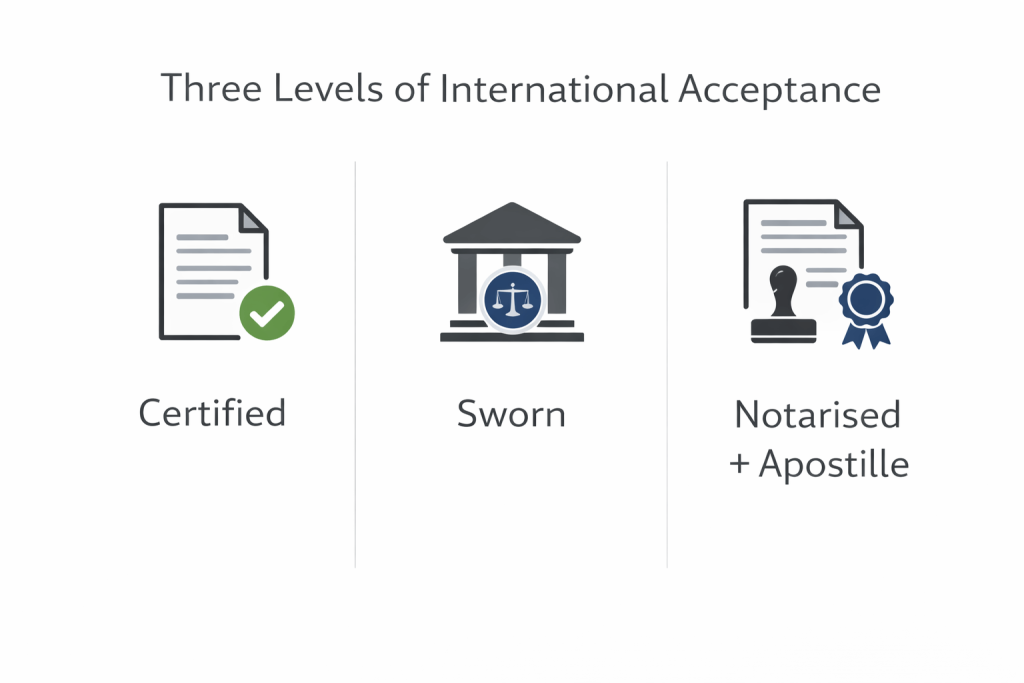
Think of international stamped translation in three levels. Your destination authority decides which one applies.
Level 1: Certified translation (most common and fastest)
You receive:
- The translation
- A certification statement confirming it’s accurate
- The translator/agency name, signature, date, and contact details
- Often a stamp (depending on format)
Best for:
- Immigration submissions that accept certified translations
- University applications that require a certified translation
- Banks, registrars, and many official workflows that need verification but not court-level formalities
Start here: Certified translations
Level 2: Sworn translation (required in many countries)
You receive:
- A translation produced by a translator who is officially authorised under that country’s rules
- A formal seal/stamp and wording required by that jurisdiction
Best for:
- Court filings abroad
- Civil status registrations abroad (depending on country)
- Processes where the authority explicitly states “sworn translation” / “court sworn translator” / “authorised translator” is mandatory
If your destination authority says “sworn only,” don’t substitute a normal agency stamp.
Explore: Sworn translation services
Level 3: Notarised + apostille / legalisation (high-authentication chain)
You receive:
- Certified translation
- Notary verification (often of the translator’s signature or declaration)
- Apostille or embassy legalisation (depending on destination country and procedure)
Best for:
- Cross-border civil status + legal procedures
- Certain business and corporate documents
- Some embassy submissions that require a chain of authentication
Start here:
“Foreign authority translation” — the most overlooked requirement
A surprisingly common reason for rejection is this:
Some authorities require the translation to be produced under THEIR system, not yours.
Examples of what this can look like:
- “Translation must be done by a translator registered in [country]”
- “Sworn translation required”
- “Translation must carry a court-appointed translator seal”
- “Translation must be legalised/notarised before submission”
That’s the real meaning behind many “foreign authority translation” requests:
The destination authority decides who can certify the translation.
When in doubt, ask your authority one sentence:
“Do you accept a UK certified translation, or do you require a sworn/authorised translator or legalisation?”
If you want, share the authority’s answer (or screenshot) and we’ll match it to the right format: Contact us.
The acceptance checklist (what your translation should include)
Even when a stamp is accepted, rejections happen because the translation package is incomplete.
A strong international stamped translation package usually includes:
- Complete translation of ALL visible text
(including stamps, seals, handwritten notes, margins, back pages, and endorsements) - Consistent spelling of names (matching passports/IDs)
- Dates converted carefully (format clarity without changing meaning)
- Correct document titles (e.g., “Birth Certificate Extract”, “Household Register”)
- Numbering and reference codes preserved
- Certification statement with:
- accuracy confirmation
- date
- translator/agency name + signature
- contact details
- Stamp/seal if required by the authority
- Matching layout when formatting matters (tables, seals, multi-page packs)
If your document is legal or high-risk (court, immigration, corporate filings), consider specialist handling: Legal translation services and What is legal translation?
Embassy translation stamp: what embassies usually want (and what they don’t)
Many people assume an embassy “stamps” the translation. In reality, embassies typically want one of the following:
- A certified translation (often acceptable for submission)
- A sworn translation (common for some consulates and civil-law jurisdictions)
- A notarised + legalised package (when embassy legalisation is part of a formal chain)
The key point: embassies rarely accept “just a stamp” with no certification statement and no verifiable translator details.
If your process involves embassy submission, use a format built for that purpose:
Embassy certified translation
Common international scenarios (and the safest format)
Immigration and visa applications
This is where certified translations are most commonly accepted—if they contain the required verification details and are fully complete.
If your documents are for visas, residency, or immigration submission, start here:
Visa translation services
Practical tip: Immigration officers commonly reject translations when stamps/seals on the original are not translated, or when the certification statement is missing contact details.
Marriage, birth, and civil status documents
Civil status documents often trigger the highest scrutiny because they affect identity, family status, and legal rights.
Depending on destination authority, you may need:
- certified translation only
- sworn translation
- notarisation + apostille/legalisation
If your civil documents will be used abroad, it’s often safer to confirm upfront whether apostille/legalisation is required:
Apostille services and Apostille translation guide
University admissions and degree recognition
Universities may accept certified translations, but some degree recognition bodies require stricter formats—especially when documents feed into licensing or regulated professions.
If the institution’s wording is vague (“must be officially translated”), ask:
- “Do you accept certified translations issued in the UK?”
- “Do you need notarisation or sworn translation?”
If you want to avoid back-and-forth, share the email screenshot and we’ll advise the correct route: Contact us.
Business documents, tenders, and corporate filings
International corporate use can involve:
- certified translation for commercial counterparties
- notarisation for legal reliance
- apostille/legalisation for cross-border filings
- sworn translation for courts or formal registries abroad
If you’re translating contracts, company docs, or filings, use a specialist workflow:
Document translation services and Legal translation services
Why “stamped translations” get rejected (top causes)
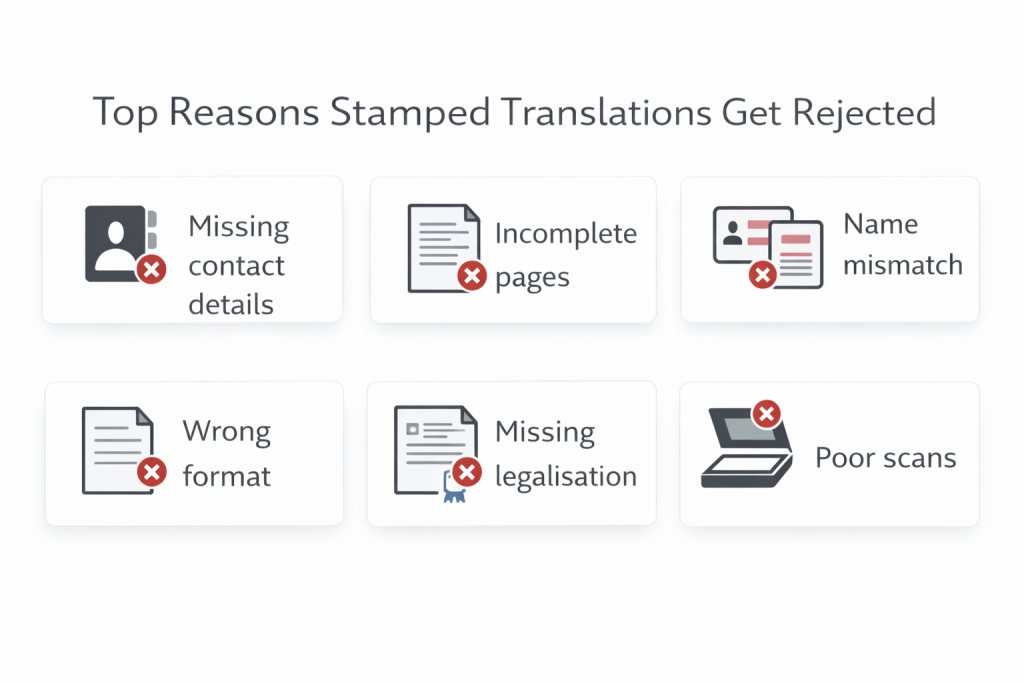
If you want acceptance on the first attempt, avoid these common pitfalls:
- Stamp with no certification statement
- Certification statement missing contact details
- Partial translation (skipping stamps, back side text, handwritten notes)
- Name mismatch (passport spelling differs from translation spelling)
- Wrong format for the country (sworn required but you submitted certified)
- No legalisation where required (apostille/embassy steps missing)
- Poor scan quality (cut-off edges, unreadable seals)
If you’re not sure which risk applies, send the destination authority + document type and we’ll tell you the lowest-risk format: Contact Locate Translate.
A practical decision checklist (copy/paste for emails to the authority)
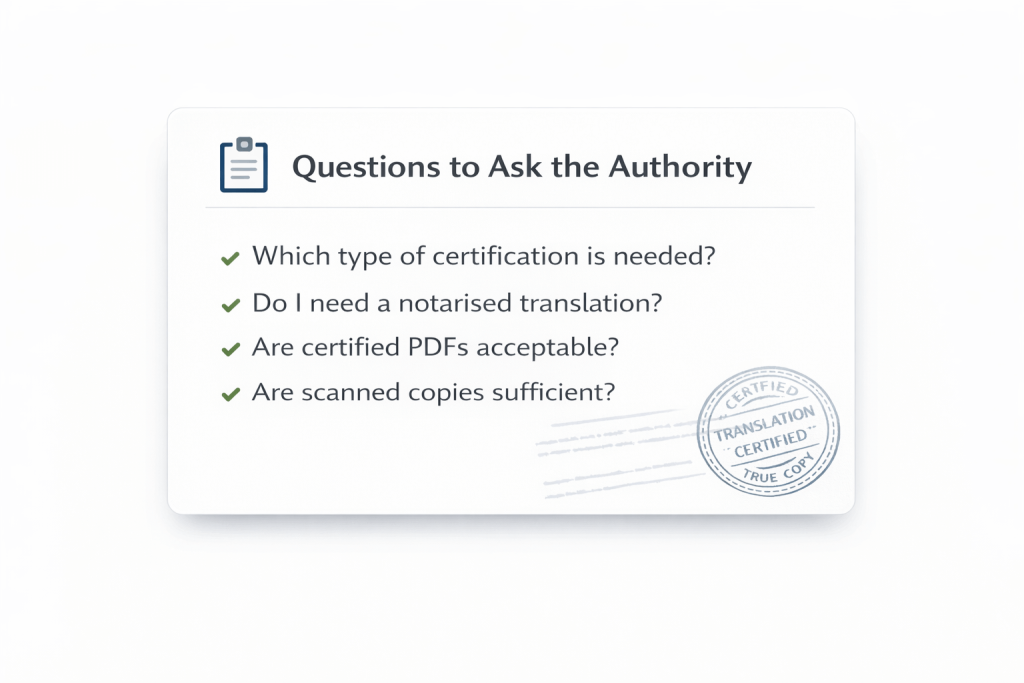
If you need a quick way to confirm requirements, send this exact message to the embassy/university/court:
- Do you accept a UK certified translation for this document?
- If not, do you require a sworn/authorised translator?
- Do you require notarisation of the translator’s declaration?
- Do you require apostille/legalisation? If yes, should it be applied to the original, the translation, or the notarial certificate?
- Do you accept digital PDFs, or do you need wet ink stamped hard copies?
- Should the translation include all stamps/seals/back pages?
Once you receive their reply, forward it to our team and we’ll deliver exactly what they asked for: Get in touch.
What you’ll receive from Locate Translate (and how it helps acceptance)
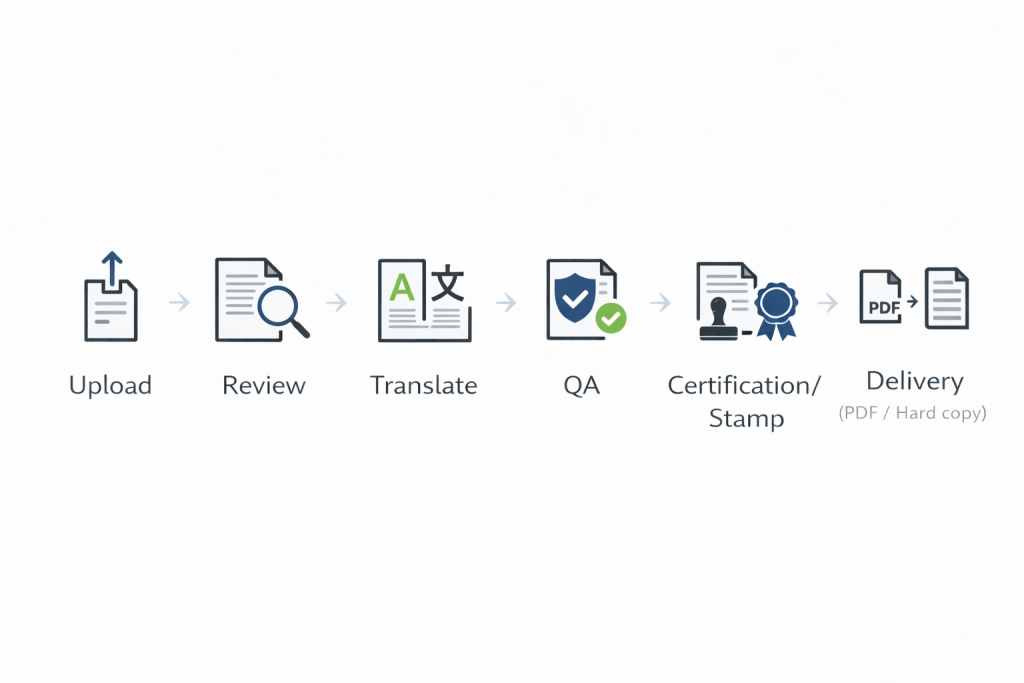
When you order an international stamped translation through Locate Translate, you can request the format aligned to your destination authority:
- Standard certified translation package: Certified translations
- Embassy-ready formats: Embassy certified translation
- Court-appointed / sworn translation handling when required: Sworn translation services
- Notary verification when needed: Notarised translation
- Legalisation/apostille options: Apostille services
You can also ask for:
- Layout matching (tables, formatting, multi-page exhibits)
- Clear scanning guidance if your file quality is the issue
- Tracked delivery of hard copies if wet-stamp originals are required
If you want the fastest route, upload the document and tell us:
(1) destination country, (2) receiving authority, (3) deadline.
Start here: Contact Locate Translate.
Quick recap (so you don’t overpay or under-prepare)
- A stamp is not automatically internationally valid. The authority decides what counts.
- “Stamped translation” might mean certified, sworn, notarised, apostilled, or embassy legalised.
- The safest method is to match the format to the authority’s wording—especially when the request includes embassy translation stamp or foreign authority translation.
If you want us to confirm the correct format and deliver it in the right style, send your file here: Contact us.
Frequently Asked Questions
Is an international stamped translation accepted in every country?
No. An international stamped translation is accepted only if the receiving authority accepts that specific format (certified, sworn, notarised, apostilled, or legalised).
What is an embassy translation stamp, and do I always need it?
An embassy translation stamp usually refers to an embassy-ready translation format. Some embassies accept certified translations; others require sworn translations or notarisation/legalisation. Always check the embassy’s stated requirement.
What does “foreign authority translation” mean?
Foreign authority translation means the receiving authority abroad has its own rules on who may translate/certify the document. It often implies sworn/authorised translators or specific legalisation steps.
Is a notarised translation the same as a stamped certified translation?
No. A notarised translation adds a notary’s verification (usually of the translator’s identity/signature). A stamped certified translation is typically a translation + certification statement (often stamped) without notary authentication.
Do I need apostille for a stamped translation to be accepted internationally?
Sometimes. Apostille/legalisation is used when the destination authority requires authentication for cross-border use. Whether you need it depends on the destination country and the authority’s procedure.
Do authorities accept digital stamped translations (PDF), or do they need hard copies?
It depends on the authority. Many accept PDFs for online submissions, but some require wet-ink stamped hard copies, notarised originals, or sealed sworn translations.