

Pricing translation is hard for one simple reason: you’re not selling “words.” You’re selling accuracy, responsibility, and outcome—often tied to real-world consequences (immigration, legal decisions, compliance, brand reputation, revenue).
This guide gives you a practical, repeatable way to price confidently—whether you’re a freelance translator, a boutique agency, or a scaling language service provider.
What You’re Really Charging For (It’s Not Just Translation)
A translation quote typically covers a bundle of work—some visible, some invisible:
- Core translation (writing in the target language)
- Research (terminology, legal/medical references, context checks)
- Quality steps (self-review, revision, second linguist review, QA tools)
- Project handling (client questions, file handling, delivery, version control)
- Formatting (tables, stamps, scanned PDFs, certificates, layout)
- Risk management (confidentiality, traceability, consistency, accuracy)
Pricing becomes easier when you separate two things:
- your base rate (the “engine”)
- your project adjustments (what makes this job harder, riskier, or more time-consuming)
The Pricing Models (and When Each One Wins)

1) Per-word pricing (most common for text)
Best for: clean, editable text (Word, Google Docs), clear word counts
How it works: you charge per source word (recommended for clarity)
Strengths: predictable, easy to compare, easy to quote
Watch-outs: can punish you for heavy formatting, research, or iterative revisions
Use per-word when:
- the text is readable/editable
- you can run a clean word count
- complexity is moderate and predictable
2) Per-page pricing (common for certificates & scanned docs)
Best for: passports, certificates, IDs, forms, documents with stamps/seals
Strengths: aligns with real effort (formatting + certification work)
Watch-outs: “page” can vary wildly—define what a “page” means
Per-page pricing is popular for certified and official documents because formatting, seals, and legibility often drive the work more than word count.
If you’re in the UK and handling official submissions, your process and output format matter. Locate Translate specializes in this workflow—see certified translation services and certified translation price guidance.
3) Hourly pricing (best for messy or multi-step work)
Best for: audio + transcription + translation, poorly scanned PDFs, research-heavy work, partial edits
Strengths: protects you when effort is unpredictable
Watch-outs: clients may fear “open-ended” costs—cap it with estimates
Use hourly when the job includes:
- heavy terminology research
- unclear source text
- multiple rounds of changes
- layout recreation from scans
4) Flat project pricing (best for outcomes)
Best for: websites, marketing campaigns, multi-file projects, onboarding packs
Strengths: clients buy an outcome; you price value + scope
Watch-outs: scope creep—define what’s included and what isn’t
This is how high-performing freelancers and agencies price confidently: the client isn’t paying for “words,” they’re paying for a finished deliverable.
5) Retainers and subscriptions (best for ongoing work)
Best for: monthly updates, product teams, legal departments, HR/onboarding
Strengths: predictable revenue, easier planning
Watch-outs: define response time, monthly volume, rollover rules
A Simple Rule: Quote the Unit That Reflects the Work
When choosing how to price translation services, ask:
- Is the workload predictable from word count? → per-word
- Is formatting/certification the main effort? → per-page
- Is the work unpredictable or multi-step? → hourly (with a cap)
- Is the client buying an outcome? → flat project fee
- Is this ongoing? → retainer
How to Build Your Base Rate (Freelancers)
If you’re asking, “how much should I charge for translation services?”, start with a base rate you can defend.
Step 1: Know your real billable capacity
Most translators are not billable 8 hours a day. Admin, quoting, email, invoicing, glossary work, tools, and learning are part of the job.
A realistic approach:
- Billable time: 3–6 hours/day (varies by niche and workflow)
- Utilization: 50–70% of your working hours in many real-world setups
Step 2: Set a minimum viable annual target
Your pricing must cover:
- income
- taxes
- tools (CAT tools, QA tools)
- insurance (where relevant)
- marketing + admin
- downtime buffer (sickness, slow periods)
Step 3: Convert that target into a base rate
Pick the unit you price in (word/hour/page/project). Then work backwards.
Example (illustrative):
- Target annual earnings (before tax): £45,000
- Business costs/tools/overhead: £6,000
- Desired buffer: £4,000
- Total target: £55,000
If you estimate 1100 billable hours/year, your minimum viable hourly rate is:
- £55,000 / 1100 = £50/hour (rounded)
From there, you translate that into per-word if needed:
- If your true average output is 400–600 words/hour including revision and research (common in specialist work), your per-word rate must reflect that reality.
The key: your base rate is a business decision, not a guess.
How to Build Your Pricing Stack (Agencies)
Agencies price differently because you’re covering more than linguistic work.
A simple agency pricing stack:
- Direct linguist cost (translator + reviewer where needed)
- Project management (coordination, client comms, file handling)
- Quality assurance (QA pass, bilingual review, checks)
- Overhead + margin (operations + profit)
Common mistake: agencies set client rates by looking at competitors, then scramble to pay linguists fairly. Reverse it:
- decide your quality process
- price the process
- protect margin with clear scope
For end-to-end service, point readers to your broader offering: translation services and niche workflows like technical translation services.
The Quote Formula That Stops Undercharging
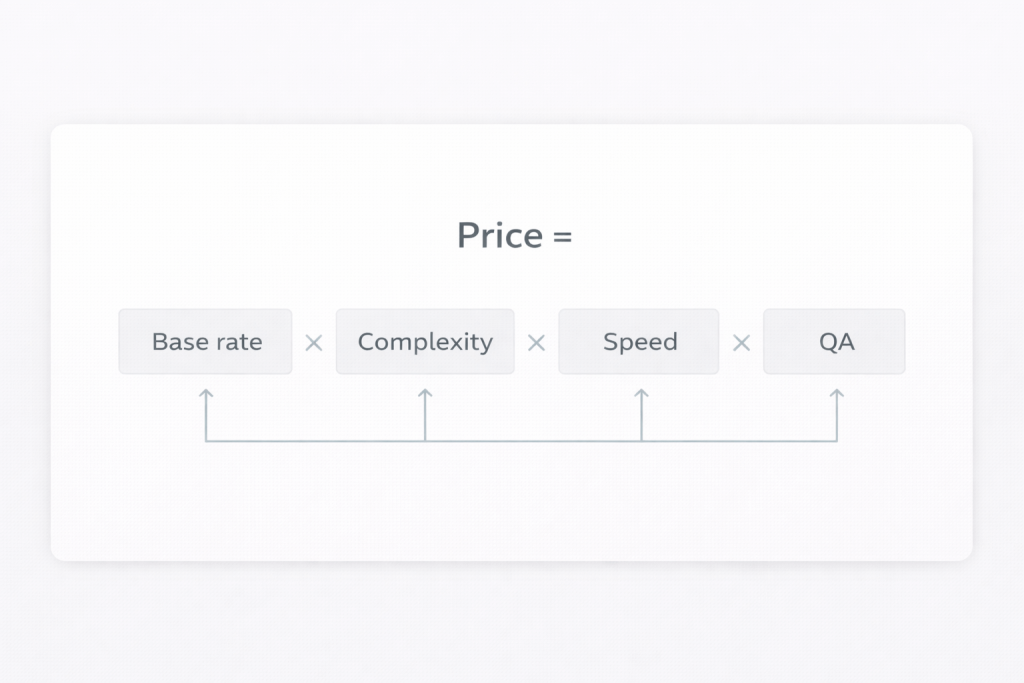
Use a repeatable quote formula that adjusts for real workload.
Base quote
Base quote = Unit price × Volume
Then apply adjustments:
Complexity multiplier
- General text: 1.0
- Specialist (legal, medical, technical): 1.2–1.8 (illustrative range)
- High-risk submissions (official/legal outcomes): higher end
Format & prep fee
Add a fee when source files are:
- scanned PDFs
- images with stamps/handwriting
- tables/forms requiring layout recreation
- multiple files needing consolidation
Urgency multiplier (rush)
Rush pricing is not “extra profit.” It compensates for:
- rescheduling other work
- extended hours
- accelerated QA steps
A clear approach:
- standard turnaround = base
- priority = base + rush multiplier
- same-day = base + higher rush multiplier
Quality steps
Be explicit about whether you include:
- revision (self-review)
- second linguist review
- bilingual proofreading
- terminology management
- QA tools pass
If a client wants “cheaper,” you can reduce scope safely:
- remove second review
- extend deadline
- simplify formatting
Instead of discounting blindly.
What to Ask Before You Quote (So Your Price Holds)

Before quoting, collect:
- Source + target language
- Purpose (immigration, court, marketing, internal use)
- File format (Word, PDF, scan, image)
- Deadline and time zone
- Certification requirement (if any)
- Delivery format (PDF, editable, hard copy)
- Any reference material (glossaries, previous translations)
- Number of stakeholders/reviewers (more stakeholders = more revisions)
A simple line that prevents disputes:
“The quote includes one consolidated round of minor edits after delivery. Rewrites or new source text are billed separately.”
When you want a fast, accurate quote, direct readers to a simple action:
- Upload the document and get a quote via Locate Translate or reach the team at hello@locatetranslate.co.uk.
Pricing Certified Translations (UK Example Without the Confusion)

Certified translations aren’t only about translating. They often involve:
- strict formatting
- stamps/seals
- certification statement
- consistency of names/dates
- verification-ready output
If you provide certified translations, your price should reflect:
- formatting time
- certification workflow
- quality and accountability
Locate Translate handles certified documents daily and provides an accepted submission-ready format: certified translations.
If a client also needs legalization, bundle it clearly:
- translation
- certification
- apostille/legalisation steps (where requested)
Relevant service page: certified translation and apostille in the UK.
“How Much Should I Pay for Translation Services?” (For Buyers)
If you’re hiring a translator or agency, the best pricing question isn’t “what’s the cheapest rate?”
It’s:
“What’s included, and what’s the risk if it’s wrong?”
A professional quote typically becomes more expensive when:
- your document is specialized (legal/medical/technical)
- the file is hard to work with (scans, handwriting)
- you need speed
- you need certification
- you need QA beyond the translator’s self-review
What to request in a quote:
- delivery date and format
- what quality steps are included
- what is excluded (formatting, revisions, certification, hard copy delivery)
- how edits are handled
If you want a quick benchmark, the simplest move is to request a quote from a provider that can explain scope clearly. Start here: contact Locate Translate.
Three Quote Examples (Practical and Easy to Copy)
These are illustrative examples to show structure—not “universal rates.”
Example 1: Clean Word document (per-word)
- Editable text
- Standard deadline
- Includes translation + revision + QA pass
Quote structure
- Translation (per word × word count)
- Minimum fee (if word count is low)
- Optional: second linguist review
Example 2: Scanned certificate (per-page)
- Scanned PDF with stamps
- Requires certification statement + formatted output
- Priority deadline
Quote structure
- Per-page certified translation fee
- Formatting/reconstruction fee (if scan is difficult)
- Priority turnaround add-on
Example 3: Agency package (3 tiers)

Offer packages to reduce negotiation and protect margin:
Standard
- translation + revision
- standard turnaround
Priority
- translation + revision + QA
- faster delivery
Premium
- translation + revision + independent review
- terminology consistency + formatting included
This makes your pricing feel like a product, not a gamble.
How to Handle Discount Requests (Without Killing Your Rate)
When a client asks for a discount, respond with a trade-off, not a haircut.
Try:
“I can reduce the price by adjusting scope. Would you prefer a longer deadline, simplified formatting, or a standard (non-priority) delivery?”
Or:
“If budget is tight, we can keep the translation quality the same and remove optional steps like second review—provided this is for internal use, not official submission.”
This protects:
- your time
- your quality
- your reputation
The Pricing Mistakes That Quietly Destroy Profit
- No minimum fee for small jobs
- No rush policy (you absorb the stress for free)
- Undercharging for formatting (scans and tables are time traps)
- Counting only translation time (ignoring admin + revisions)
- Not defining what “edits” include
- Assuming per-word fits every job
- Pricing like a commodity instead of a professional service
A “Profit-Safe Quote” Checklist
Before sending any quote, confirm:
- I know the file format and how messy it is
- I know the deadline and can meet it without rushing quality
- I’ve priced formatting and admin time (if needed)
- I’ve set a minimum fee (for small jobs)
- I’ve defined what revisions are included
- I’ve included quality steps appropriate to the document’s risk
- The quote includes delivery format (PDF, editable, hard copy if required)
If you want the fastest route to an accurate quote, the simplest step is to upload your file and request a quote here: Locate Translate.
FAQ
How do I price translation services as a freelancer?
Start with a base rate that covers income, tools, and non-billable time. Then adjust per project for complexity, formatting, urgency, and required quality steps. Use per-word for clean editable text, per-page for certificates/scans, and hourly when effort is unpredictable.
How do I charge for translation services—per word or per hour?
Charge per word when word count reflects the real work (clean files, predictable content). Charge per hour when the job includes heavy research, poor scans, transcription, complex formatting, or multiple steps that make word count misleading.
How much should I charge for translation services?
There isn’t one universal rate. Your price should reflect your specialization, turnaround, file complexity, and the risk of errors. A solid approach is: set a minimum viable base rate from your financial needs, then add clear multipliers for complexity, formatting, and urgency.
How much should I pay for translation services?
Expect to pay more when the work is specialist (legal/medical/technical), urgent, or requires certification and formatting. Ask what quality steps are included (revision, review, QA) and ensure the quote defines what revisions and delivery formats are covered.
What should be included in a translation quote?
At minimum: languages, volume, delivery date, file format assumptions, quality steps included, revision policy, formatting/certification fees (if applicable), and total price. A professional quote also clarifies what triggers additional charges (new source text, extra revision rounds, layout recreation).
Should I charge extra for certified translations?
Yes—certified translations often require additional formatting, a certification statement, and verification-ready output. Pricing commonly reflects the document type and formatting effort more than raw word count.