

If you’re wondering how much do translation services cost, the honest answer is: it depends on what you’re translating, how fast you need it, and whether it must be certified for official use. The good news is you can usually estimate a realistic range in under two minutes once you know the pricing model and the few factors that move the price most.
This guide breaks down how translation pricing works in plain English, with real-life examples you can compare to your project.
Need an exact price today? Get a fast, fixed quote here: Request a Free Quote
The shortest answer: typical UK price ranges you’ll actually see
Translation services are usually priced in one of these ways:
- Per word (most common for business, legal, marketing, technical documents)
- Per page / per document (common for certificates and official personal documents)
- Per hour (rare for written translation; more common for editing, formatting, interpreting)
- Fixed project fee (common when files are messy, multi-format, or need extra services)
A practical “quick range” guide
While every quote is unique, these are useful ballparks for many UK projects:
- General translation (per word): often priced as a per-word rate for the source text
- Specialist translation (legal/medical/technical): usually higher due to terminology and risk
- Certified translation for official use: often priced per page/document, because layout + certification are part of the deliverable
If your document must be accepted by the Home Office/UKVI, universities, courts, or other authorities, you’ll typically want a certified translation. See what’s included here:
Certified Translation Services
What you’re paying for (and why “cheap” can get expensive fast)
A professional translation isn’t just “words swapped into another language.” Pricing reflects:
- A qualified translator in your language pair and subject area
- Quality checks (proofreading/revision, terminology consistency, formatting checks)
- Project handling (file prep, delivery format, turnaround management)
- Accountability (a service you can contact if an institution asks questions)
For official documents, you’re also paying for certification — a signed statement and the correct presentation format that institutions expect.
If you want the safest route for official use:
Order a Certified Translation
The four main ways translation services are priced

1) Per-word pricing (the standard for most written translation)
This is the most common model for professional documents.
Best for:
- Contracts, policies, reports, websites, manuals, marketing copy, medical documents
Why per-word is popular:
- Transparent: you can estimate quickly based on word count
- Scales fairly for larger documents
A simple estimate formula
Estimated cost = word count × per-word rate
Then adjust for complexity, urgency, and add-ons (formatting/certification).
2) Per-page / per-document pricing (common for certified translations)
This is common for:
- Birth certificates, marriage certificates, diplomas, driving licences, police certificates, bank statements, etc.
Per-page pricing makes sense because certificates usually require:
- Careful layout replication
- Labels/stamps/signatures formatting
- A certification statement
Explore certified options here:
Certified Translation Services
3) Hourly pricing (less common for translation)
Hourly pricing usually applies to:
- Editing, rewriting, transcreation workshops
- File engineering and complex formatting
- Interpreting (phone/video/in-person)
If you need interpreting rather than document translation, start here:
Translation, Interpreting & Transcription Services
4) Fixed project pricing (best when files are “non-standard”)
Some projects are quoted as a fixed fee when the work is not just translation, such as:
- Scanned PDFs that need reconstruction
- Multi-file brand packs
- Desktop publishing and design adjustments
If your file needs layout work across languages:
Multilingual Desktop Publishing
What affects translation cost the most (ranked by impact)
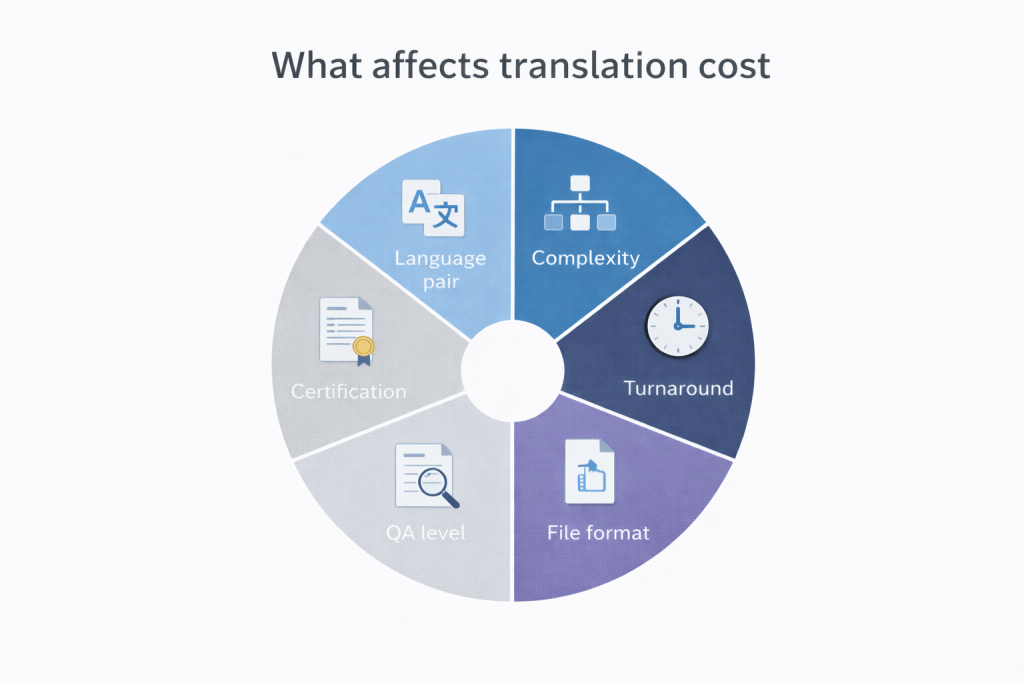
1) Language pair (and how common it is)
Some language pairs have a larger pool of qualified translators, which can reduce cost. Rare languages or niche pairs often cost more simply due to availability and specialist expertise.
You can check supported options here:
Languages We Translate
2) Subject matter complexity (legal/medical/technical vs general)
The going rate for translation services climbs when accuracy has consequences.
Examples of higher-complexity work:
- Legal (contracts, court documents, affidavits)
- Medical (reports, discharge summaries, patient letters)
- Technical (engineering specs, manuals, safety documentation)
If you’re translating specialist materials:
3) Turnaround time (standard vs urgent)
Urgent work costs more because it changes how the project is staffed:
- More translators may be assigned
- Additional revision steps may be compressed but still required
- Weekend/evening delivery may be needed
Tip: If your deadline is flexible by even 24 hours, you can often reduce the price.
4) File format and “hidden” production work
Two documents with the same word count can cost differently if one is:
- A clean Word file, and the other is a low-quality scan
- Packed with tables, stamps, handwritten notes, or complex formatting
For design-heavy documents, DTP may be required:
Multilingual Desktop Publishing
5) Quality level (translation only vs translation + revision)
Many clients assume “translation” is one step. Professional workflows often include:
- Translation
- Revision (a second linguist checks the work)
- Final QA (formatting and completeness)
How much do certified translation services cost?
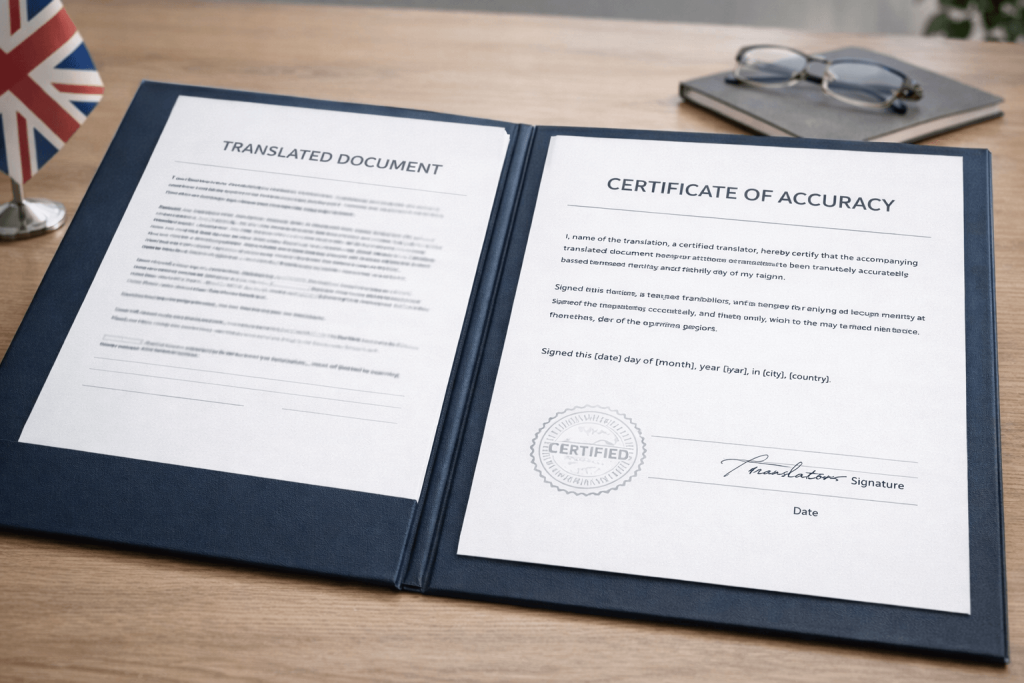
Certified translations are priced differently because the deliverable isn’t just the text — it’s the official-ready package.
A certified translation typically includes:
- The translated document (formatted appropriately)
- A signed certificate of accuracy
- The date and translator/company details
- A signature and stamp/seal where required
If your document is for UK authorities, universities, courts, or regulated bodies, certified translation is the safer choice:
Certified Translation Services
Fast route: upload your document and get a fixed quote:
Request a Free Quote
Real-world cost examples (so you can benchmark your project)
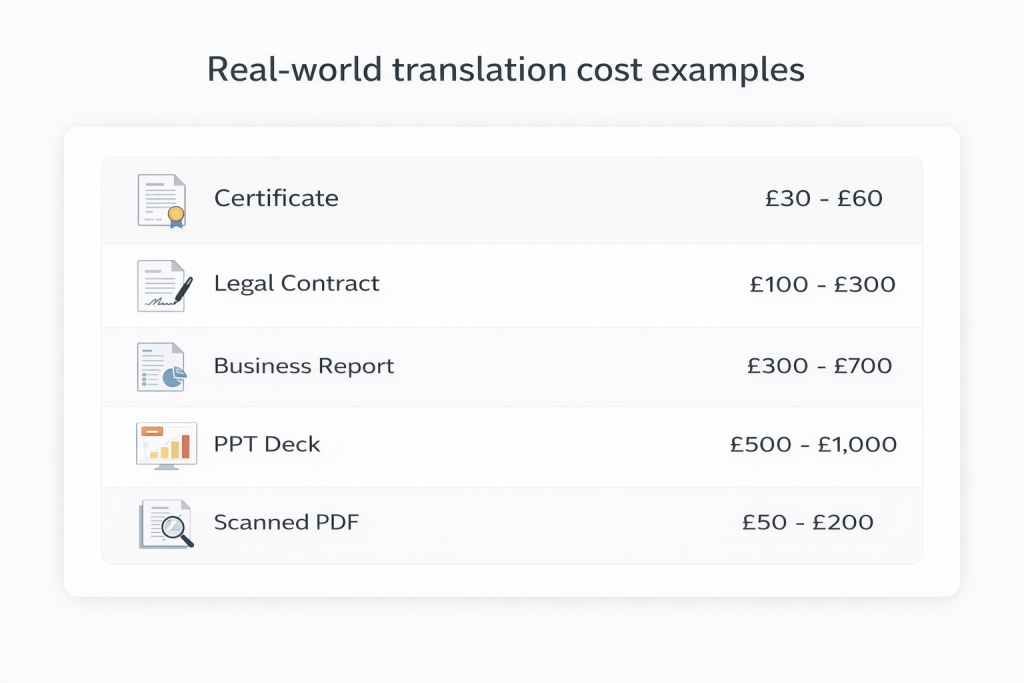
These examples show how quotes typically behave. Your exact price depends on language pair, formatting, and deadline.
Example 1: 1,000-word business document (standard speed)
- Typical pricing model: per word
- Common use: HR policy, company profile, supplier agreement
Example 2: 2-page birth certificate for official use
- Typical pricing model: per page/document
- Includes: formatting + certificate of accuracy
- Common use: visa, passport, marriage, university
Example 3: 3,500-word legal contract (urgent)
- Typical pricing model: per word + urgency factor
- Needs: legal terminology accuracy + careful QA
Example 4: 12-slide PowerPoint pitch deck (needs design consistency)
- Typical pricing model: fixed fee (translation + DTP)
- Needs: layout adjustments for text expansion and font support
Example 5: 6-page scanned PDF (non-editable)
- Typical pricing model: fixed fee
- Includes: reconstruction/formatting before translation
If you want a quote based on your actual file (not a guess), upload it here:
Request a Free Quote
How to reduce your translation cost (without reducing quality)
If you’re cost-sensitive, these steps help most:
- Send an editable file (Word/Excel/PPT instead of scanned PDF)
- Highlight what must be translated (e.g., only relevant pages of bank statements)
- Bundle documents together to reduce admin time
- Share reference materials (previous translations, glossaries, brand terms)
- Avoid artificial urgency — if it’s not truly urgent, don’t pay urgent pricing
Red flags: when “cheap translation” becomes risky
Be cautious if a provider:
- Won’t confirm who translated the document
- Avoids explaining what “certified” includes
- Can’t support the formatting your institution expects
- Promises “instant” human translation for complex documents
- Doesn’t offer a clear way to correct issues if an authority asks questions
For official submissions, the cost of a rejected application can be much higher than the cost difference between providers.
How much does the NHS spend on translation services?
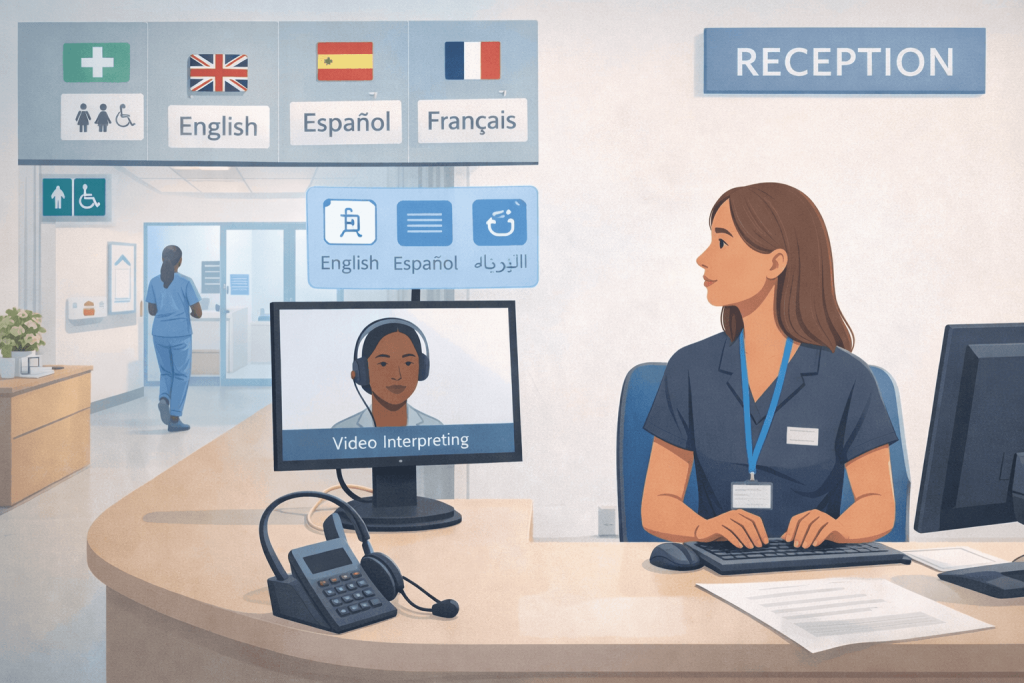
People often ask “how much does the NHS spend on translation services” because it highlights how essential language access is in healthcare.
A helpful way to understand it:
- Interpreting (phone/video/in-person) is a major driver of cost because it needs staffing and availability, not just word count.
- Written translation supports letters, patient info, consent forms, and public communications.
- Costs vary significantly by region, language needs, and whether British Sign Language is included.
Public frameworks and procurement arrangements are designed to ensure coverage, quality, and patient safety — so the headline figure you see in the news is not always the same thing as actual yearly spend.
Frequently asked questions
How much are translation services for a one-page document?
For personal documents (like certificates), pricing is often per page/document rather than per word. The price changes based on language pair, formatting, and whether certification is required for official use.
What is the average cost for translation services?
Most projects fall into predictable bands once you know: language pair, word count, complexity, deadline, and whether you need certified translation. The fastest way to get a reliable number is a file-based quote.
What is the going rate for translation services?
The going rate varies widely. General text is typically priced lower than specialist legal, medical, or technical work. Urgent delivery and formatting needs also push the rate up.
How much for translation services if I need it urgently?
Urgent work usually costs more because it requires priority resourcing and tighter QA timelines. If you can extend the deadline even slightly, ask for a standard option to compare.
How much do certified translation services cost in the UK?
Certified translations are usually priced per page/document because certification and formatting are part of what you’re buying. If your documents are for UKVI/Home Office or official bodies, certified translation is the safest option.
How much is a translation service for my language pair?
Language availability matters. Some pairs are more common and may be more cost-effective; rarer pairs may cost more due to specialist availability.
Check supported languages here: https://locatetranslate.co.uk/languages/