

If you’re asking who pays for legal aid interpreting in London, you’re usually asking one thing: “Will I have to pay out of pocket to understand what’s happening?” In most legally aided situations, the answer is no—but who pays depends on where the interpreting happens and who arranged it.
Here’s the simplest way to think about it:
- In court/tribunal hearings: the court service typically arranges and pays for the interpreter for the hearing.
- For legally aided solicitor meetings (outside the hearing): the solicitor arranges the interpreter, pays the invoice, then claims it back as a legal aid disbursement.
- At a police station interview: the police usually arrange and pay for interpreting for the interview itself.
If you’re a solicitor or caseworker, the key is getting the paperwork and approvals right so reimbursement is smooth. If you’re a client, the key is telling your solicitor early and providing the right language details.
Need an interpreter quickly in London? You can request interpreters for legal matters through our interpreting services team, with clear booking notes and invoice-ready documentation.
The difference between “court interpreting” and “legal aid interpreting”
These two get mixed up all the time—especially in London where hearings, conferences, and client meetings can happen on the same day.
Court interpreting is interpreting that the court or tribunal provides so a party/witness can participate in the hearing.
Legal aid interpreting is interpreting arranged as part of a legally aided case, often for:
- solicitor–client conferences
- statement taking
- instructions before/after hearings
- conferences with experts
- conferences with counsel
- urgent prep meetings (including remote)
Sometimes both are needed:
- the court provides the interpreter in the courtroom
- the solicitor may need an interpreter outside court to take instructions properly
Who pays for legal aid interpreting in London? A practical decision guide
Use this quick guide to pinpoint who pays.
If the interpreter is needed for a court or tribunal hearing
Most of the time, the court/tribunal arranges and pays for the interpreter for the hearing.
What you should do:
- Tell the court/tribunal you need an interpreter as early as possible (or ask your solicitor to do it).
- Confirm the language + dialect and any access needs (e.g., BSL, hearing loop, remote option).
If the interpreter is needed for solicitor–client communication (legally aided)
In legally aided matters, the solicitor usually arranges the interpreter, pays the invoice, then claims reimbursement through legal aid as a disbursement—subject to the applicable rules and rates.
What you should do:
- Tell your solicitor you need interpreting for meetings and calls (not just the hearing).
- Ask the firm to confirm whether they need any pre-approval for the cost.
If the interpreter is needed at the police station
For the interview itself, the police typically arrange and pay the interpreter. If your solicitor needs an interpreter to take instructions outside the formal interview, that may be handled separately (and could fall under legal aid if you qualify).
If the interpreter is needed for other public bodies (Home Office, local authority, NHS)
For official interviews/meetings required by that body, it’s often the responsibility of the organisation requiring attendance to ensure communication access. Your legally aided solicitor may still need a separate interpreter for legal advice and instructions around those meetings.
The London “who pays” table (save this)
| Situation in London | Who usually pays? | Who books the interpreter? | What can go wrong if not handled properly? |
|---|---|---|---|
| Court/tribunal hearing (in-hearing) | Court/tribunal | Court staff / listing office | Interpreter booked for hearing only; no coverage for solicitor instructions |
| Solicitor–client meeting (legally aided) | Solicitor pays, then claims back | Solicitor / caseworker | No prior approval where needed; poor attendance record; rate disputes |
| Police station interview | Police | Police | Separate interpreter may still be needed for legal advice outside interview |
| Conference with counsel/expert (legally aided) | Solicitor pays, then claims back | Solicitor | Costs deemed excessive without justification; missing breakdown |
| Translating key documents in a legally aided case | Solicitor pays, then claims back | Solicitor | Volume not authorised; wrong pricing model; delays in assessment |
| Non-legally aided private matter | Client | Client / solicitor / agency | Client unexpectedly billed; unclear scope; cancellation fees |
Legal aid interpreter rates in London (what people actually mean by “rates”)
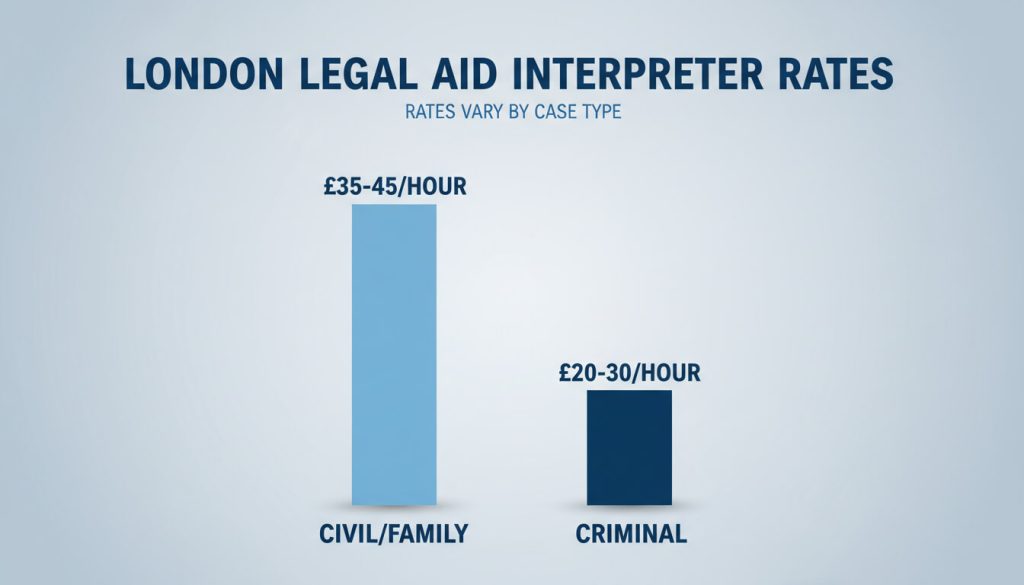
When people search legal aid interpreter rates or legal aid rates interpreters, they’re usually trying to understand:
- whether there’s a standard capped rate, and
- what happens if the language is rare or urgent.
In practice, legal aid remuneration uses prescribed rates for interpreters in different categories (civil/family vs criminal), and different London/non-London bands.
London rate snapshot (commonly applied)
While exact allowances depend on the case type and assessment rules, London is often referenced as:
- Civil/family legally aided interpreting in London: £25/hour (typical prescribed maximum)
- Criminal legally aided interpreting in London: £29/hour (typical prescribed maximum)
Other cost lines that commonly affect total cost:
- waiting time at court (where allowable)
- travel time rules (treated differently by case type)
- mileage caps
- minimum call-out time in some circumstances (needs justification)
Tip for solicitors: if the booking is likely to exceed standard limits (rare language, urgent, multi-hour waiting), plan for the reimbursement path before the interpreter attends.
Need a rate-appropriate quote fast? Upload your details and get a clear, written estimate via our Contact Us page—we’ll include language, dialect, mode, duration, and any travel/waiting assumptions.
“Do I have to pay?” The honest answer (and the exceptions)
If you qualify for legal aid, you usually should not be personally paying for interpreting that is necessary for your representation. But there are a few situations where you might still face costs or delays.
You may have to pay (or be asked to pay) if:
- Legal aid isn’t in place yet (no certificate/authority granted and you proceed privately)
- the work is outside scope of what’s funded
- you insist on using a specific interpreter at a rate that isn’t recoverable
- cancellations happen late and the arrangement terms make you liable (this should be agreed clearly up front)
You usually should not pay if:
- your solicitor confirms the interpreting is necessary and justified for your legally aided representation
- the interpreter is booked through appropriate channels and documentation is maintained
- any required pre-approval is obtained in advance
Prior approval and “prior authority” in plain English
This is the number one reason reimbursement gets messy.
Prior authority (or pre-approval) is essentially:
“We’re asking permission to incur this interpreting cost at this level, so it won’t be reduced later.”
It’s commonly needed when:
- the language is rare or specialist and market rates exceed the cap
- the assignment is urgent/out-of-hours
- the booking includes long waiting time, long travel time, or minimum attendance requirements
- there are multiple interpreters, multiple sessions, or extended conferences
Practical best practice:
- get a written quote with a clear breakdown (hourly rate, minimum time, travel, waiting assumptions)
- keep attendance notes signed where possible
- record why interpreting was necessary and why alternatives weren’t workable
If you’re a provider firm looking to reduce assessment friction, our team can structure quotes and invoices to support legal aid reimbursement in a clean, auditor-friendly format. See our commitment to quality standards for confidentiality and process controls.
How to request an interpreter for a legally aided case in London
Whether you’re a client or a legal professional, this checklist prevents 90% of problems.
Step 1: Confirm the exact language requirements
Don’t just say “Arabic” or “Kurdish.” Use:
- language + dialect (e.g., Levantine Arabic vs Maghrebi Arabic; Sorani vs Kurmanji)
- preferred interpreter gender (if relevant)
- any safeguarding considerations
- any accessibility requirements (e.g., BSL)
Step 2: Choose the mode that fits the risk
- Face-to-face: best for statements, sensitive conferences, complex hearings
- Remote (video/telephone): often faster for urgent instructions and quick updates
- Hybrid: common in London when hearings run late or move lists
For remote hearings or prep, our Zoom interpretation services can support multi-party conferences with clear turn-taking protocols.
Step 3: Provide a “booking brief” (copy/paste template)
Include:
- case type (civil/family/crime/tribunal)
- venue (court name + address) or remote link
- estimated start/end time + whether waiting time is likely
- topic summary (e.g., “witness statement – housing disrepair”)
- documents the interpreter should review (where appropriate and permitted)
Step 4: Keep the admin tight
- confirm cancellation terms in writing
- ensure invoice references the correct matter
- keep attendance confirmation (time in/time out)
Fastest way to book: message our team through Contact Us with the booking brief—London coverage is easiest when we have the full details upfront.
Why quality matters more in legal aid cases than people assume
The highest-cost “interpreting mistake” is rarely the invoice—it’s the knock-on impact:
- misunderstood instructions
- incomplete statements
- adjournments and wasted hearings
- credibility issues in evidence
Legal interpreting should be:
- accurate and complete (no “tidying up”)
- impartial
- confidential
- consistent with legal terminology
If you need courtroom-grade support, explore our face-to-face interpreting options for legal matters in London.
Real-world London scenarios (mini case examples)
Scenario 1: Client qualifies for legal aid and needs a solicitor conference before court
- Who pays? Solicitor pays the interpreter invoice, then claims it back as a disbursement.
- What matters? A clear note explaining why interpreting was needed and an attendance record.
Scenario 2: Client needs an interpreter at a tribunal hearing
- Who pays? The tribunal usually provides and pays for the hearing interpreter.
- What matters? Early notice—last-minute bookings can limit dialect availability.
Scenario 3: Rare dialect + urgent same-day conference
- Who pays? Still legal aid route, but you may need pre-approval to avoid reductions.
- What matters? Evidence of scarcity and a written quote.
How Locate Translate helps London legal teams keep interpreting simple
When the question is “who pays,” what you’re really trying to avoid is surprise billing and reimbursement delays.
Here’s what we focus on:
- clear, written quotes aligned to the matter type
- interpreter matching by language, dialect, and legal context
- secure handling of sensitive information
- invoice-ready documentation to support legal aid claims
- fast booking options for London timetables
Client feedback (legal interpreting):
“Our clients needed an interpreter for their complex legal matter… their interpreting service was second to none!” — Jane Wilkinson, Solicitor
If you need legally-focused interpreting or translation support alongside interpreting (statements, evidence, bundles), see our legal translation services.
Ready to book? Send the booking brief via Contact Us and we’ll confirm availability, mode, and a clean estimate.
FAQ
Who pays for legal aid interpreting in London for solicitor meetings?
In most legally aided cases, the solicitor arranges the interpreter, pays the invoice, and then claims the cost back through legal aid as a disbursement—provided the interpreting is necessary and properly documented.
Are legal aid interpreter rates in London fixed?
Legal aid interpreter rates are typically controlled by prescribed maximums that vary by case type. In London, rates commonly referenced include £25/hour for civil/family and £29/hour for criminal, but the recoverable amount depends on the relevant rules and assessment.
Who pays for an interpreter in a London court hearing?
For the hearing itself, the court or tribunal typically arranges and pays for the interpreter so the party or witness can participate. This may not automatically cover private solicitor–client discussions outside the hearing.
Can the Legal Aid Agency refuse to pay interpreting costs?
Yes, if the cost is considered unjustified, excessive, outside scope, or missing supporting records. Where higher-than-standard costs are expected, pre-approval is often the safest route.
Do I have to use a specific interpreter on legal aid?
Usually, your solicitor will book an interpreter who meets the requirements for the case and is available at a recoverable rate. If you insist on a specific interpreter at a higher rate, you may risk unrecoverable costs.
Does legal aid cover translation as well as interpreting?
Often yes, where translation is necessary for the legally aided case. Translation and interpreting are usually treated as disbursements and should be documented and justified like other expert costs.