

If you’ve ever needed a document accepted by an authority, launched a website in another country, or tried to communicate with a client who speaks a different language, you’ve already met the real purpose of translation: making meaning portable.
Translation services are professional services that convert content from one language into another without changing the intent—while keeping the right tone, terminology, and formatting for the situation. Depending on what you need, translation can also include certification, localisation, transcreation, desktop publishing, subtitling, or even post-editing of machine translation.
This guide explains what translation services do, the most common types, real examples, and the practical steps behind how a translation service works—so you can choose the right option confidently.
What translation services do (in plain English)
Translation services do more than “swap words.” A professional translation service typically supports you by:
- Rewriting meaning accurately in the target language (not word-for-word copying)
- Using correct terminology for your industry (legal, medical, technical, finance, etc.)
- Adapting style and tone (formal, marketing-led, academic, conversational)
- Preserving layout and formatting (tables, stamps, letterheads, page order, figures)
- Adding quality checks (review, proofreading, consistency checks)
- Providing certification when the document must be accepted by authorities
- Ensuring confidentiality and data security for sensitive files
If you’re asking “what is a translation service?”—the simplest answer is:
A translation service helps you communicate clearly and correctly in another language, with the level of accuracy, formatting, and proof required for the purpose.
For business and regulated use cases, that “purpose” is everything.
Translation services vs interpreting services (and why it matters)

People often search for “what are interpreting and translation services” because they’re related—but they’re not the same.
The core difference
- Translation = written content (documents, websites, contracts, reports)
- Interpreting = spoken or signed communication (meetings, hearings, calls)
Here’s a quick comparison:
| Feature | Translation | Interpreting |
| Format | Written | Spoken / Signed |
| Timing | Delivered after work is completed | Real-time or near real-time |
| Common uses | Certificates, contracts, websites, manuals | Court, medical appointments, conferences |
| Quality focus | Terminology, accuracy, formatting | Accuracy, speed, tone, neutrality |
| Output | A translated document/file | Live language transfer |
If you need both, many projects combine them—for example, an international dispute might require translated evidence plus court interpreting.
Internal links (Locate Translate):
- Interpreting support: https://locatetranslate.co.uk/interpreting-services-moderation-global/
- Arabic interpreting: https://locatetranslate.co.uk/arabic-interpreting/
Translation, localisation, and transcreation: what’s the difference?
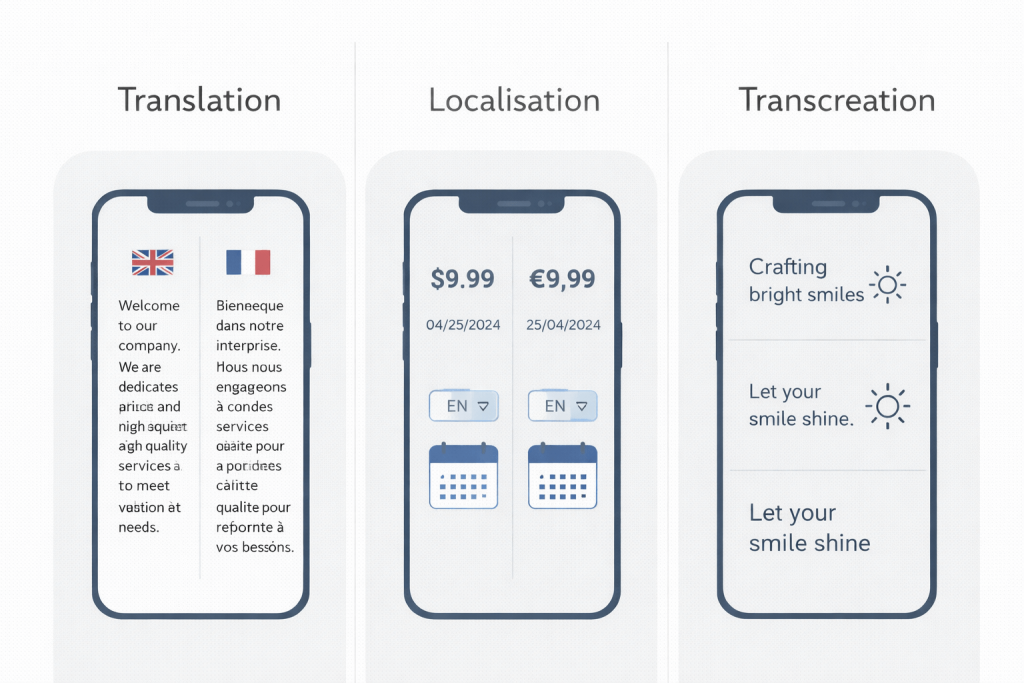
Another common search is “what is translation and localization services” (or “translation and localisation”). Here’s the difference in practical terms:
Translation
Transfers meaning accurately into another language.
Example: Translating a contract from Spanish into English.
Localisation
Adapts content to feel native in a specific region/culture—often includes dates, currency, UI constraints, tone, and visuals.
Example: Adapting a UK eCommerce website for Saudi Arabia (Arabic language, local conventions, right-to-left layout, currency, customer expectations).
Internal link:
- Localisation services: https://locatetranslate.co.uk/localisation-services-translation/
Transcreation
Recreates marketing copy to preserve emotion and persuasion, not just meaning. Especially useful for slogans, campaigns, luxury, and ads.
Example: Rewriting a tagline so it sells in the target market rather than sounding “translated.”
Internal link:
- Marketing & transcreation: https://locatetranslate.co.uk/marketing-and-transcreation/
Types of translation services (most common categories)

When people ask “what are translation services,” they usually mean one of these types. The right choice depends on who will read it, what it will be used for, and how much risk there is if something is wrong.
1) Certified translation (for official acceptance)
A certified translation includes a signed statement confirming accuracy and translator details, so it can be used for official submissions.
Common examples:
- Birth, marriage, death certificates
- Passports / IDs
- Visa and immigration documents
- Academic transcripts and diplomas
- Bank letters and legal declarations
Internal link:
- Certified translations: https://locatetranslate.co.uk/certified-translations/
2) Legal translation
Legal translation demands exact meaning, consistent terminology, and careful handling of jurisdiction-specific concepts.
Common examples:
- Contracts and agreements
- Court filings and witness statements
- Terms & conditions
- Powers of attorney
- Compliance documents
Internal link:
- Legal translation insights: https://locatetranslate.co.uk/what-is-legal-translation/
3) Medical translation
Medical translation prioritises clarity and correct terminology—because ambiguity can cause delays, rejections, or risk.
Common examples:
- Medical reports and discharge summaries
- Consent forms and patient leaflets
- Clinical research materials
- Insurance medical evidence
4) Technical translation
Technical translation requires subject knowledge and consistency across product families and documentation.
Common examples:
- Manuals, datasheets, specifications
- Engineering documentation
- Safety instructions
- Patents and product documentation
Internal link:
- Technical translation: https://locatetranslate.co.uk/technical-translation-services/
5) Business and financial translation
Used for corporate operations, deals, and stakeholder communication.
Common examples:
- Annual reports and investor decks
- Company formation documents
- Financial statements and audits
- Banking and compliance documents
Internal link:
- Business translation: https://locatetranslate.co.uk/business-translation-services/
6) Website and app translation
Often needs localisation, character limits, UI awareness, and sometimes SEO considerations (done correctly, not mechanically).
Common examples:
- Website pages, landing pages, help centres
- App UI strings and store listings
- Product descriptions and onboarding screens
Internal links:
- App translation: https://locatetranslate.co.uk/app-translation-services/
- Translate website to English: https://locatetranslate.co.uk/translate-website-to-english/
7) Subtitling, voiceover, and media translation
This includes timing, readability constraints, and sometimes script adaptation.
Internal link:
- Subtitling & voiceover: https://locatetranslate.co.uk/subtitling-and-voiceover-services/
8) Proofreading and editing (monolingual or bilingual)
Sometimes you don’t need full translation—you need the target language polished professionally.
Internal link:
- Proofreading: https://locatetranslate.co.uk/proofreading/
9) Machine translation + human post-editing (MTPE)
Useful for high volume content where speed matters—but still needs a professional human editor to correct meaning, tone, and terminology.
Internal link:
- MT post-editing: https://locatetranslate.co.uk/machine-translation-postediting/
Real examples: what translation services look like in everyday life
Here are practical examples showing the type of service you’d choose:
Example A: “I need this document accepted”
You’re submitting non-English documents to an authority, university, solicitor, or bank.
Best fit: Certified translation (sometimes notarised, depending on the destination).
Why: The translation needs proof of accuracy and verifiable translator details.
Internal link:
- Certified translations: https://locatetranslate.co.uk/certified-translations/
Example B: “I’m closing a deal internationally”
You’re signing a contract, negotiating terms, or handling compliance documents.
Best fit: Legal translation (often with a second review).
Why: Small wording changes can alter obligations and risk.
Example C: “We’re launching in a new market”
You need your website, app, or marketing to feel local.
Best fit: Localisation + (sometimes) transcreation.
Why: Literal translation can be correct but still underperform commercially.
Internal links:
- Localisation: https://locatetranslate.co.uk/localisation-services-translation/
- Transcreation: https://locatetranslate.co.uk/marketing-and-transcreation/
Example D: “We have recordings and need them in writing”
Interviews, hearings, focus groups, podcasts, or research recordings.
Best fit: Transcription + translation (when needed).
Why: It turns audio into usable, shareable text—and can be translated after.
Internal link:
- Transcription: https://locatetranslate.co.uk/transcription/
How translation services work (step-by-step)
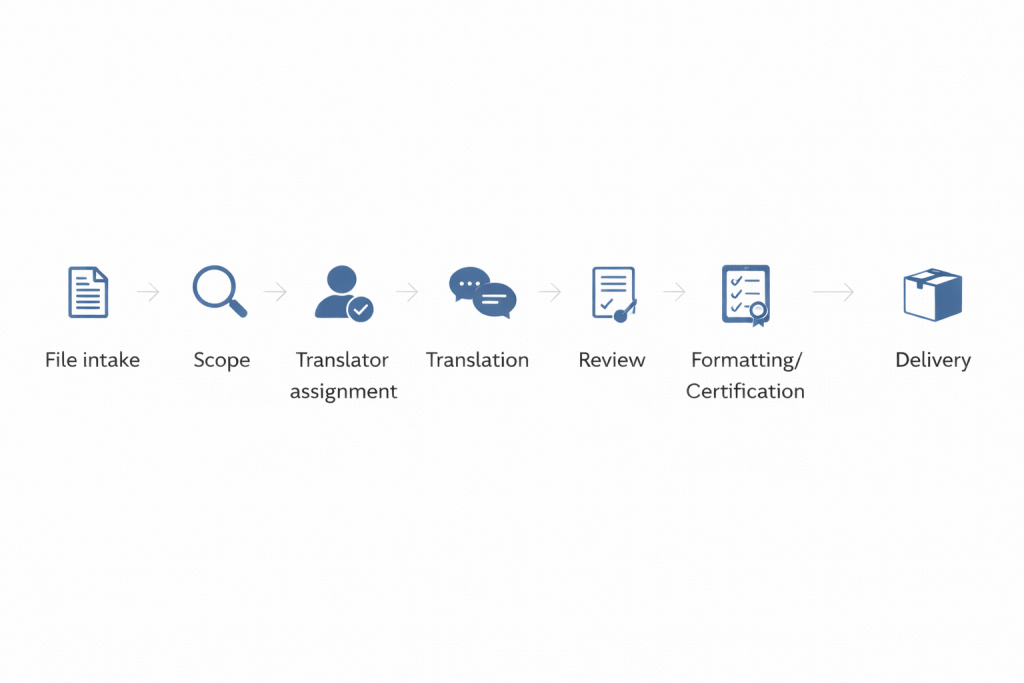
If you’ve been wondering “what do translation services do behind the scenes?”—this is the typical workflow used by professional providers.
Step 1: You share the file and the purpose
A good provider will ask:
- What is it for? (visa, court, business, website, internal use)
- Where will it be used? (country/authority)
- What format do you need? (PDF, Word, same layout, certified statement)
- When do you need it? (standard vs urgent)
Best practice: Send the clearest scan or editable file you have.
Natural next step: Upload your file for a quote and confirm your deadline before work begins.
Internal link:
- Contact / quote: https://locatetranslate.co.uk/contact-us/
Step 2: Scope is confirmed (and risks are flagged)
This is where professional services differ from casual translation:
- Complex formatting is identified (tables, stamps, handwritten notes)
- Specialist terminology is noted
- Certification requirements are clarified
Step 3: The right linguist is assigned
Professional translation isn’t just “someone bilingual.”
The translator should match:
- Language pair and regional variant
- Industry knowledge (legal/medical/technical)
- Required level (certified, reviewed, formatted)
Step 4: Terminology and reference preparation
For business and technical work, the provider may create or apply:
- A glossary
- A style guide
- Translation memory (for consistency across updates)
Step 5: Translation (meaning-first, purpose-first)
The translator produces a first version focused on:
- Accurate meaning
- Correct tone and register
- Natural readability
- Correct handling of names, dates, numbers, and units
Step 6: Review and quality checks
Many professional workflows include:
- A second linguist review (especially for legal/medical)
- Proofreading for typos, consistency, and formatting
- Automated QA checks (number mismatches, missing text, consistency flags)
Step 7: Formatting (and certification if required)
For official use, the translation is packaged properly:
- Layout preserved where needed
- Certification statement added
- Translator details included as required
- Stamps/signatures applied (if applicable)
Step 8: Delivery and support
You receive:
- Your translated file(s)
- Any certification pages
- A clear path for corrections if something in the source scan was unclear
What makes a translation “professional” (and what to look for)
If you’re comparing options and asking “what is translation services in a professional sense?”—this is the checklist that separates professional work from risky shortcuts.
Professional translation should include:
- Purpose-fit wording (official vs marketing vs technical tone)
- Terminology control (consistent, correct industry terms)
- Formatting awareness (tables, stamps, page order, names)
- Quality review (at least proofreading; often a second linguist for high-risk texts)
- Clear accountability (especially for certified translations)
- Confidential handling (secure transfer and storage)
Red flags to avoid:
- “We translate anything into any language instantly”
- No questions asked about purpose or destination
- No mention of certification statement details (for official use)
- Extremely low pricing that ignores complexity
- No process for review or corrections
How pricing usually works (and what affects cost)
If you’ve ever wondered why two quotes can differ, it’s usually because the work isn’t “just words.”
Common pricing units:
- Per word (common for general and business documents)
- Per page (common for certificates and formatted official documents)
- Per hour / per session (common for interpreting)
- Per minute (common for transcription/subtitling)
Factors that most affect price:
- Language pair and rarity
- Subject complexity (legal/medical/technical)
- Urgency (same-day vs standard)
- Formatting and layout recreation
- Certification / notarisation requirements
- File type (scanned PDF vs editable Word)
- Volume and repetition (glossary + translation memory can reduce cost over time)
Practical tip: If acceptance matters, price should be weighed against risk. A rejected submission can cost more than the translation itself.
Mini toolkit: a translation request brief you can copy-paste
Want faster quoting and fewer follow-up questions? Use this template when you contact a provider:
Translation Request Brief
- Languages: [From] → [To]
- Purpose / destination: [e.g., UK visa, court, university, internal use]
- Delivery format: [PDF, Word, same formatting, certified statement]
- Deadline: [date + time zone]
- Notes: [names must match passports / keep stamps / keep page order]
- Special terms: [industry terms, product names, legal clauses]
- Confidentiality: [NDA required? yes/no]
Result: clearer scope, better turnaround planning, fewer surprises.
When you need certified translation (and when you don’t)
Many people overpay here because the terms are confusing.
You likely need certified translation when:
- Submitting to immigration/visa processes
- Applying to universities or professional bodies
- Using documents in legal or official contexts
- Providing proof to banks, employers, or registries
You might not need it when:
- Translating internal emails, informal content, drafts
- Translating a blog post for general reading
- Translating content where acceptance isn’t being checked formally
If you’re unsure, the safest approach is simple:
Ask the destination body what they require (certified, notarised, sworn, or standard), then match the service level to that requirement.
Internal link:
- Certified translations: https://locatetranslate.co.uk/certified-translations/
Translation and interpretation services: how to choose the right mix
Searches like “what do translation and interpretation services do” often come from people who need both written and spoken support in the same project.
Use this quick guide:
- Documents + meetings: translate documents first, interpret the meeting second
- Court/legal: legal translation + court/public service interpreting
- Healthcare: medical translation for records + interpreting for appointments
- International conferences: multilingual interpreting + translated materials (agenda, slides, signage)
Internal link:
- Interpreting services: https://locatetranslate.co.uk/interpreting-services-moderation-global/
A simple decision guide (fast, practical)
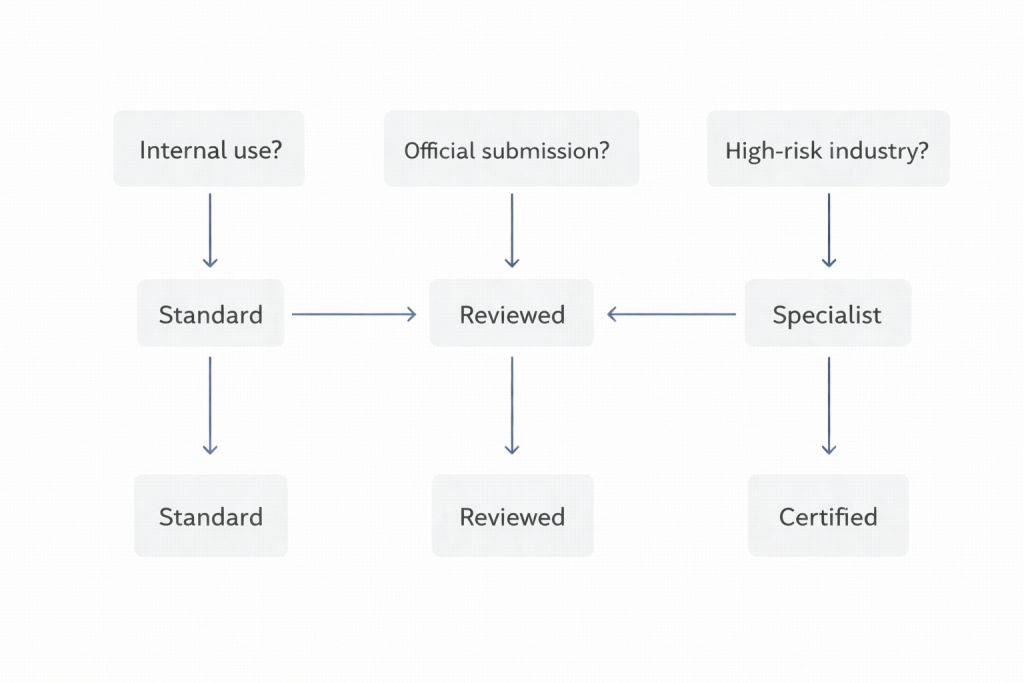
If you only read one section, make it this one.
Choose standard translation if:
- It’s for internal understanding
- There’s low risk if wording isn’t perfect
- No authority needs proof
Choose professional reviewed translation if:
- It’s customer-facing or public
- Brand voice matters
- Errors create reputational risk
Choose specialist translation if:
- It’s legal, medical, technical, or financial
- Terminology must be exact
- A misunderstanding creates cost or liability
Choose certified translation if:
- A body will assess acceptance
- The translation must be verifiable and accountable
Ready to translate something important?
If your document needs to be accurate, presentable, and accepted where it’s being submitted, the easiest next step is to upload your file and request a quote—including your deadline and destination requirements.
You can also call or message for the fastest turnaround guidance.
Internal link:
- Contact & file upload: https://locatetranslate.co.uk/contact-us/
- Translation services overview: https://locatetranslate.co.uk/translation/
Frequently Asked Questions
What are translation services?
Translation services convert written content from one language into another while preserving meaning, tone, terminology, and (when needed) formatting and certification for official acceptance.
What is a translation service?
A translation service is a professional service that delivers a complete translated output—often including review, formatting, and quality checks—so the translated content is usable for its real purpose (official, business, legal, medical, or marketing).
What are translation and interpretation services?
Translation and interpretation services cover both written and spoken language support. Translation is for documents and text. Interpretation is for live spoken communication (in-person, phone, or video).
What do translation services do besides translating words?
They manage terminology, keep formatting consistent, adapt tone, run quality checks, and (when required) provide certified statements and verifiable translator details for official use.
What is translation and localisation services?
Translation transfers meaning into another language. Localisation adapts the translation to a specific region and culture—often changing conventions like currency, dates, UI layout, and phrasing so it feels native.
What is translation and interpreting services used for most often?
Translation is commonly used for certificates, contracts, websites, manuals, and reports. Interpreting is commonly used for legal settings, healthcare appointments, business meetings, and conferences.