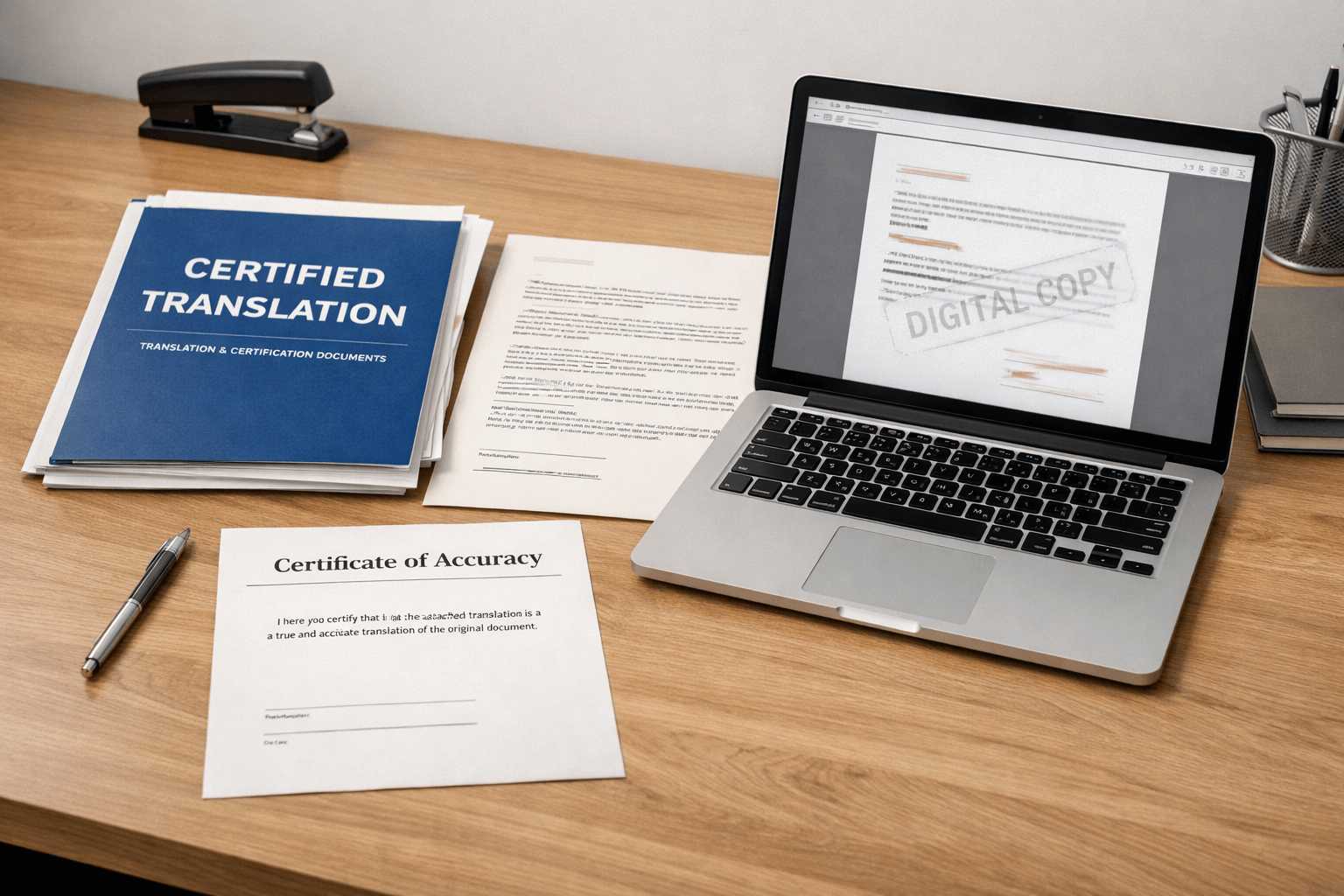
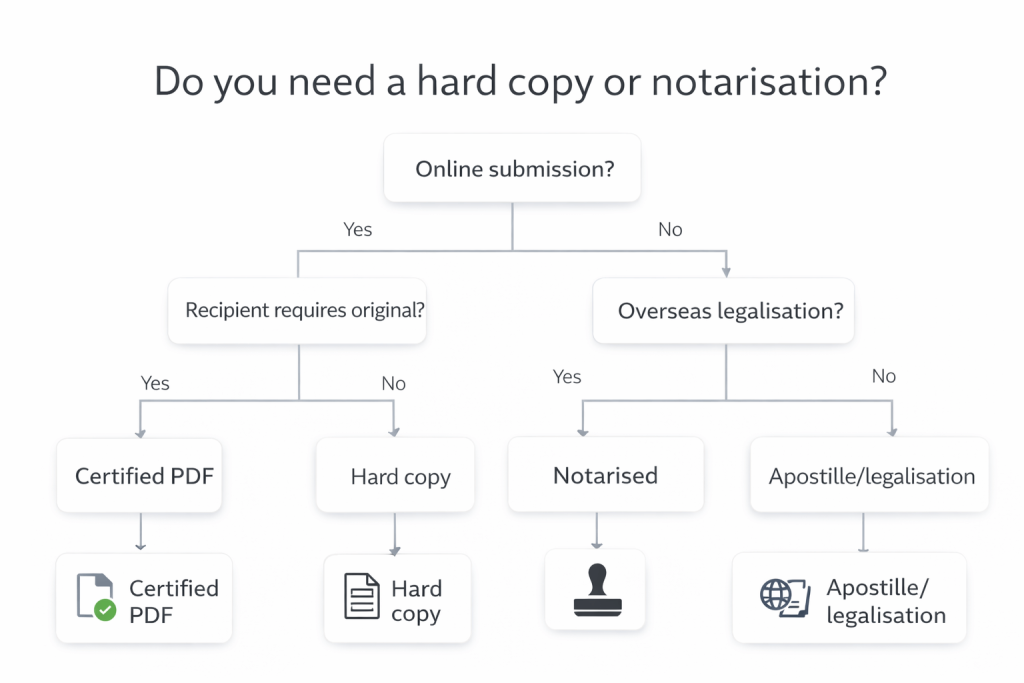
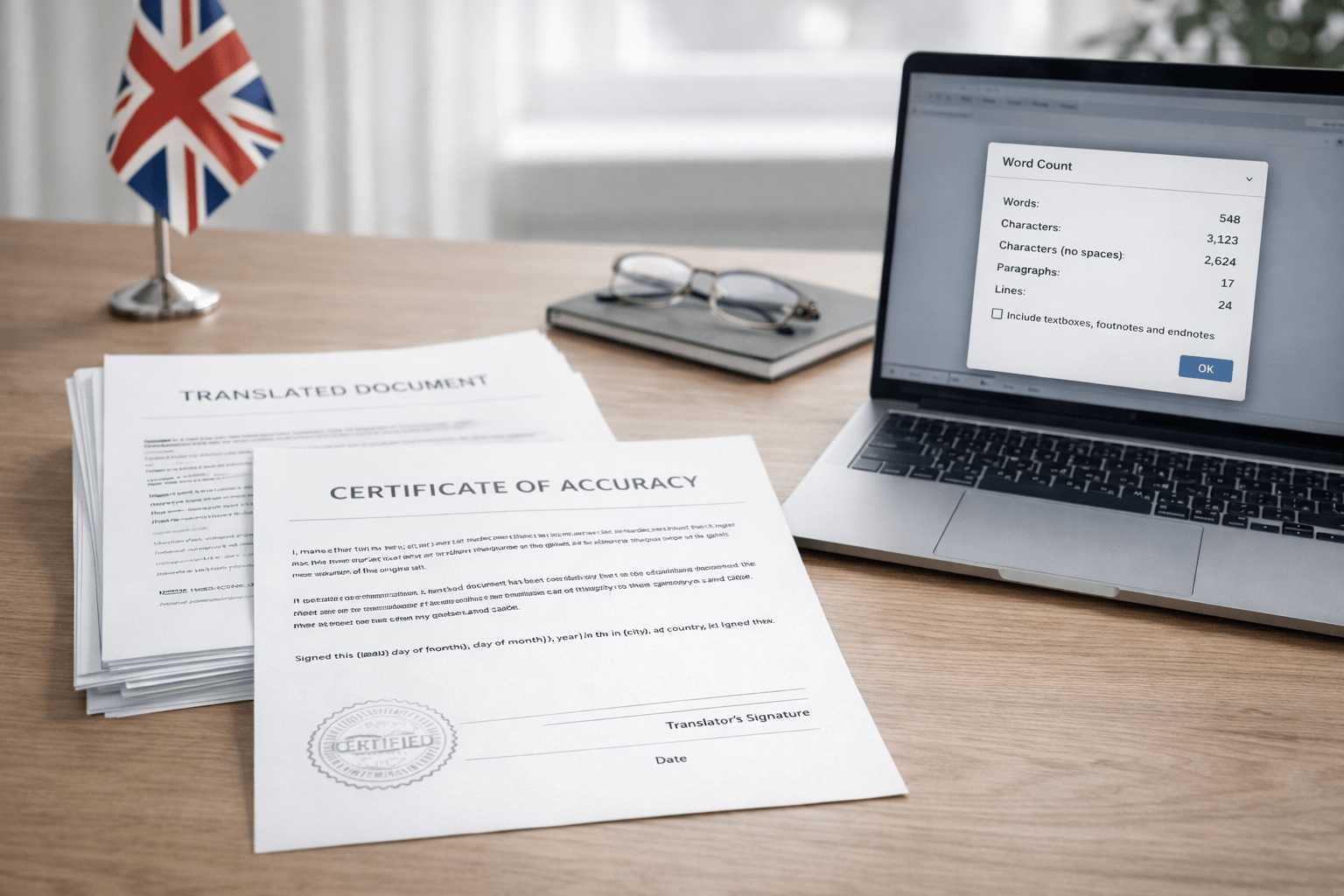
If you need a digital stamped translation (an electronic translation stamp on a PDF—often called a PDF stamped translation), the real answer is: often yes, but it depends on the receiving authority and the type of “digital stamp” used. Some offices accept a certified PDF instantly. Others still require a wet-ink original, a bound pack, or notarisation/legalisation.
This guide explains what’s usually accepted, what triggers rejections, and how to get a translation stamped in the right format the first time—without guesswork.
The quick answer
A digital stamped translation is commonly accepted when:
A paper translation is signed and stamped physically, then scanned into PDF.
Often accepted because it resembles the traditional format, just delivered digitally.
2) Electronic stamp image placed onto a PDF
A stamp graphic is applied directly to the PDF (with a signature image).
Can be accepted—but it’s easier to edit if the PDF isn’t locked or digitally signed.
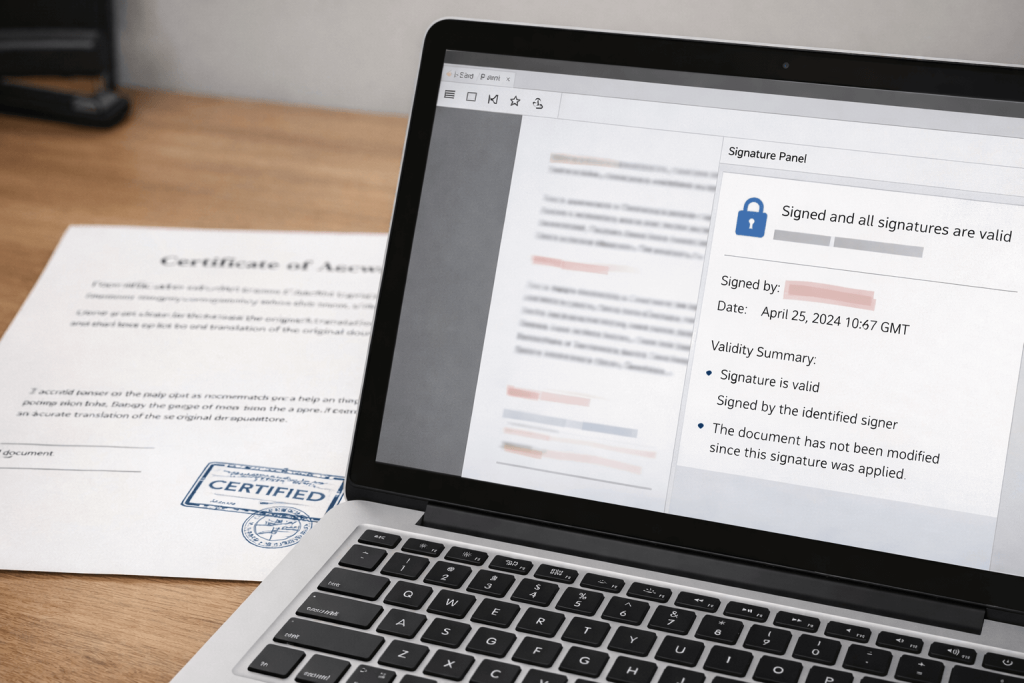
3) True digital signature (cryptographic PDF signature)
The PDF is electronically signed in a way that shows if the file has been altered.
Best for security and audit trails, but not every authority understands or requires it.
Key point: Most rejections happen because the receiving body expected one type, and the applicant submitted another.
What authorities usually care about more than the stamp
In many official scenarios, the stamp is helpful—but the certification details are what make the translation usable.
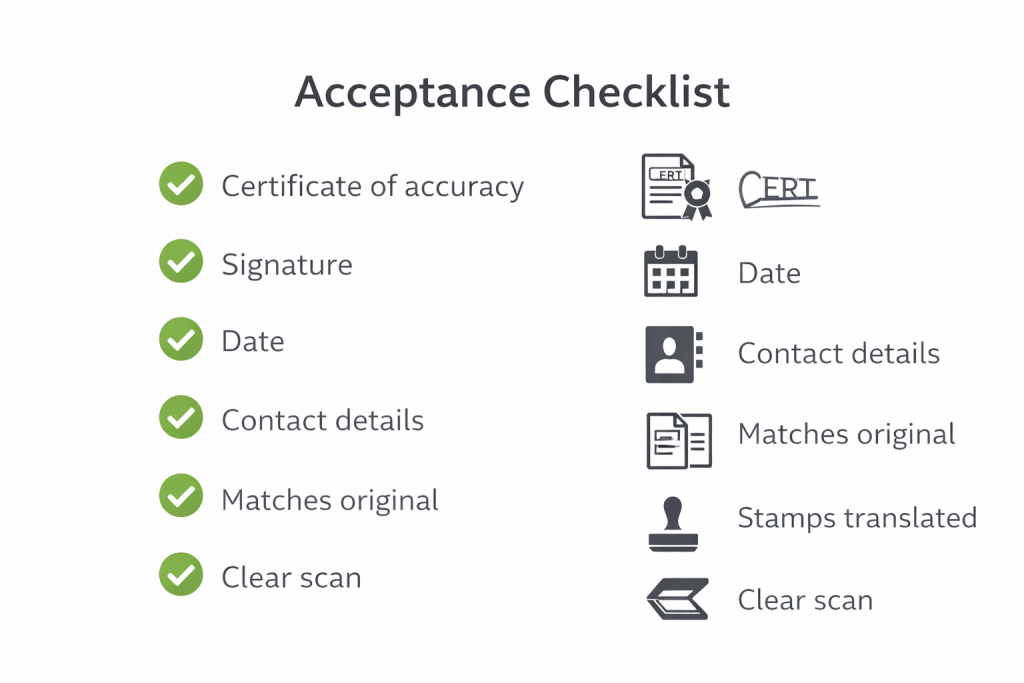
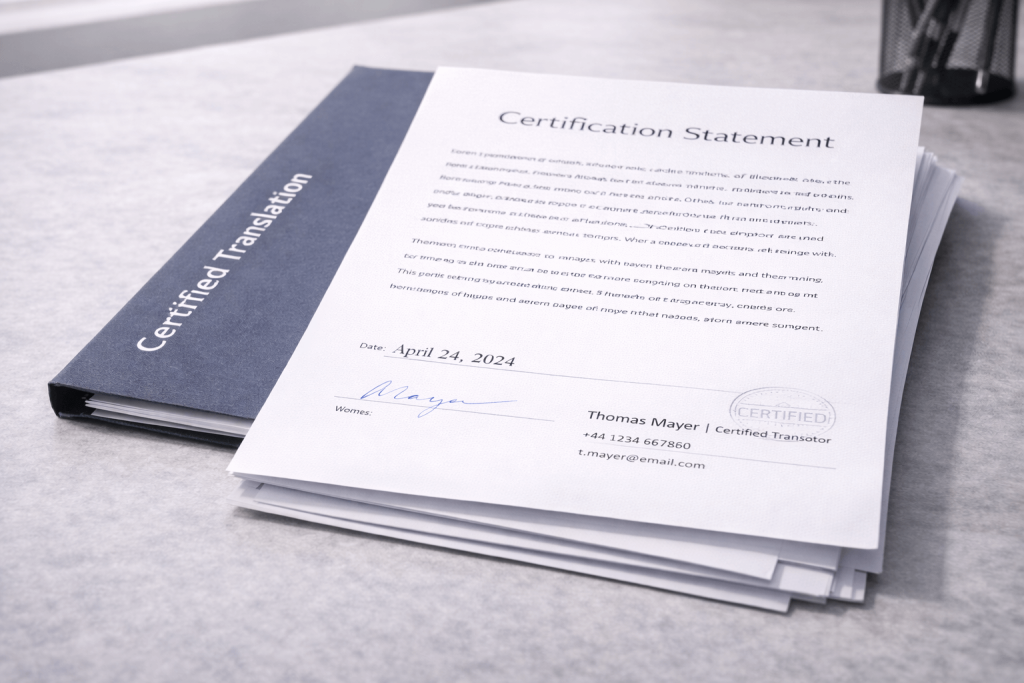
A strong certified translation pack typically includes:
A statement confirming the translation is true and accurate
Translator or agency name
Signature
Date
Contact details for verification
Clear linkage to the source document (reference to “attached copy” or “original seen”)
If any of the above is missing, a translation can be rejected even if it has a stamp.
When a PDF stamped translation is usually enough
Below are common real-world situations where a PDF stamped translation is often accepted—especially when the submission is digital.
Online immigration and visa applications
Many immigration processes rely on uploading documents. A certified PDF is usually the practical format, provided the certification statement is complete and the document is readable.
Tip: If you’re uploading multiple supporting documents, keep naming consistent (e.g., Passport_Translation_Certified.pdf) and avoid screenshots or compressed scans.
Universities, employers, professional registration bodies
Educational and HR teams often accept certified PDFs because they store and verify documents digitally. They usually want:
clarity,
a certification statement,
and a way to contact the translator/agency.
Banks, landlords, insurers, general compliance checks
These organisations typically want a document they can file and verify quickly—PDF is often preferred, but requirements vary by internal policy.
When digital stamping may NOT be enough
If the institution demands an original hard copy
Some recipients still require:
wet-ink signature,
wet stamp,
or a bound/attached set (translation + source copy) delivered physically.
If the email says “original only,” don’t gamble—request a posted copy.
If you need notarisation
A notarised translation adds a legal layer: a notary confirms the identity/signature involved in the certification process (and sometimes how the document was executed). This is often requested for overseas authorities or legal procedures.
If a foreign authority requires legalisation, the translation may need to be prepared in a format suitable for that route (often involving notarisation/solicitor certification before legalisation).
Getting a digital stamped translation from Locate Translate
At Locate Translate, we prepare certified translations in an official format designed for real-world acceptance—typically delivered as a signed and stamped PDF, ready for online submission.
Before you upload or email your translation, confirm:
The PDF is readable (no blur, no cropped edges)
The certification statement includes accuracy confirmation, date, signature, and contact details
Names and dates match the source exactly
Stamps/seals on the original have been translated (if relevant)
You’re using the format the receiving body accepts (PDF vs hard copy vs notarised)
If you want the safest route with minimal delays: request the certified PDF first, then add hard copy or notarisation only if the receiving authority requires it.
Frequently Asked Questions
Are digital stamped translations accepted for official use?
A digital stamped translation is often accepted for official use when the receiving body allows PDF stamped translation submissions and the certification details are complete.
What is an electronic translation stamp on a PDF?
An electronic translation stamp is a stamp applied to a translation delivered digitally—either as a stamp image on a PDF or via a secure digital signature—used alongside a certification statement.
Is a PDF stamped translation the same as a notarised translation?
No. A PDF stamped translation is usually a certified translation delivered digitally. A notarised translation includes an additional legal authentication step performed by a notary.
Will UK authorities accept a digital stamped translation?
Many UK submissions are handled online, so a certified PDF is commonly suitable. However, acceptance always depends on the receiving department’s current rules and the document’s purpose.
Can I print a digital stamped translation and use it as an “original”?
Sometimes yes, sometimes no. Some recipients accept a printed certified PDF; others explicitly require a wet-stamped hard copy issued by the translation provider.
How do I avoid rejection when ordering a digital stamped translation?
Ensure the certification statement is complete, the source document is scanned clearly, and you confirm whether the recipient needs hard copy, notarisation, or legalisation.
If you’re wondering how much do translation services cost, the honest answer is: it depends on what you’re translating, how fast you need it, and whether it must be certified for official use. The good news is you can usually estimate a realistic range in under two minutes once you know the pricing model and the few factors that move the price most.
This guide breaks down how translation pricing works in plain English, with real-life examples you can compare to your project.
The shortest answer: typical UK price ranges you’ll actually see
Translation services are usually priced in one of these ways:
Per word (most common for business, legal, marketing, technical documents)
Per page / per document (common for certificates and official personal documents)
Per hour (rare for written translation; more common for editing, formatting, interpreting)
Fixed project fee (common when files are messy, multi-format, or need extra services)
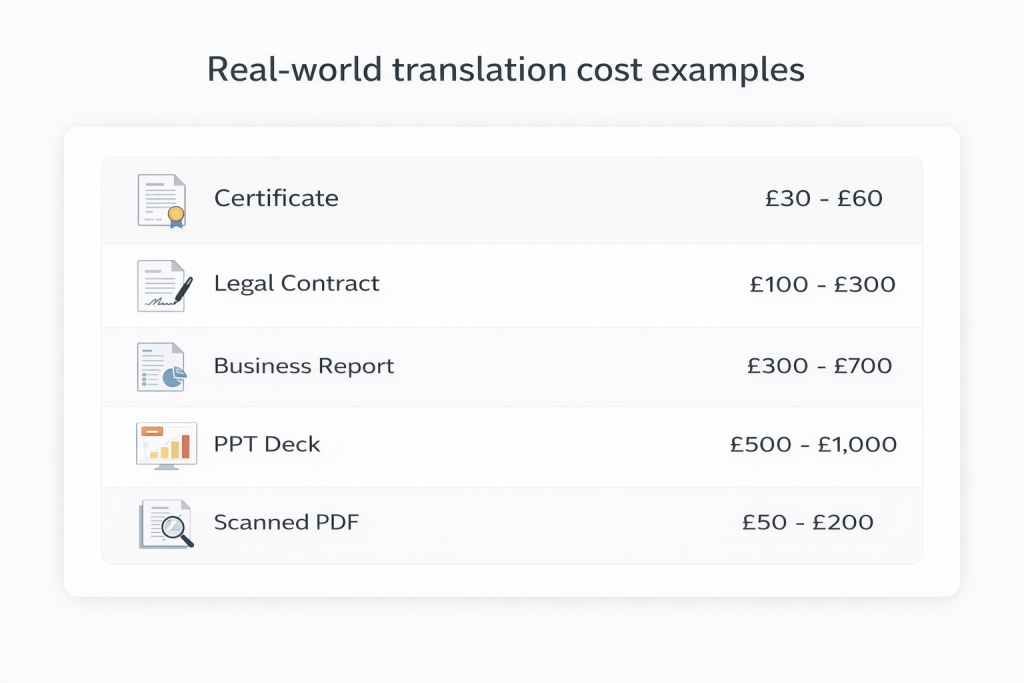
A practical “quick range” guide
While every quote is unique, these are useful ballparks for many UK projects:
General translation (per word): often priced as a per-word rate for the source text
Specialist translation (legal/medical/technical): usually higher due to terminology and risk
Certified translation for official use: often priced per page/document, because layout + certification are part of the deliverable
If your document must be accepted by the Home Office/UKVI, universities, courts, or other authorities, you’ll typically want a certified translation. See what’s included here: Certified Translation Services
What you’re paying for (and why “cheap” can get expensive fast)
A professional translation isn’t just “words swapped into another language.” Pricing reflects:
A qualified translator in your language pair and subject area
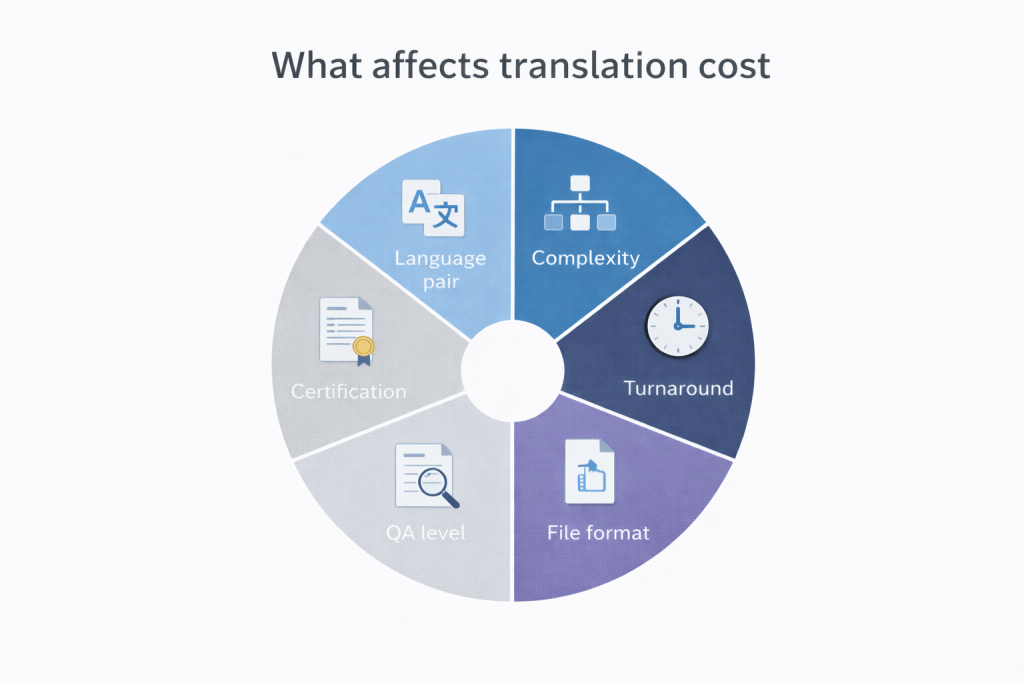
What affects translation cost the most (ranked by impact)
1) Language pair (and how common it is)
Some language pairs have a larger pool of qualified translators, which can reduce cost. Rare languages or niche pairs often cost more simply due to availability and specialist expertise.
5) Quality level (translation only vs translation + revision)
Many clients assume “translation” is one step. Professional workflows often include:
Translation
Revision (a second linguist checks the work)
Final QA (formatting and completeness)
How much do certified translation services cost?
Certified translations are priced differently because the deliverable isn’t just the text — it’s the official-ready package.
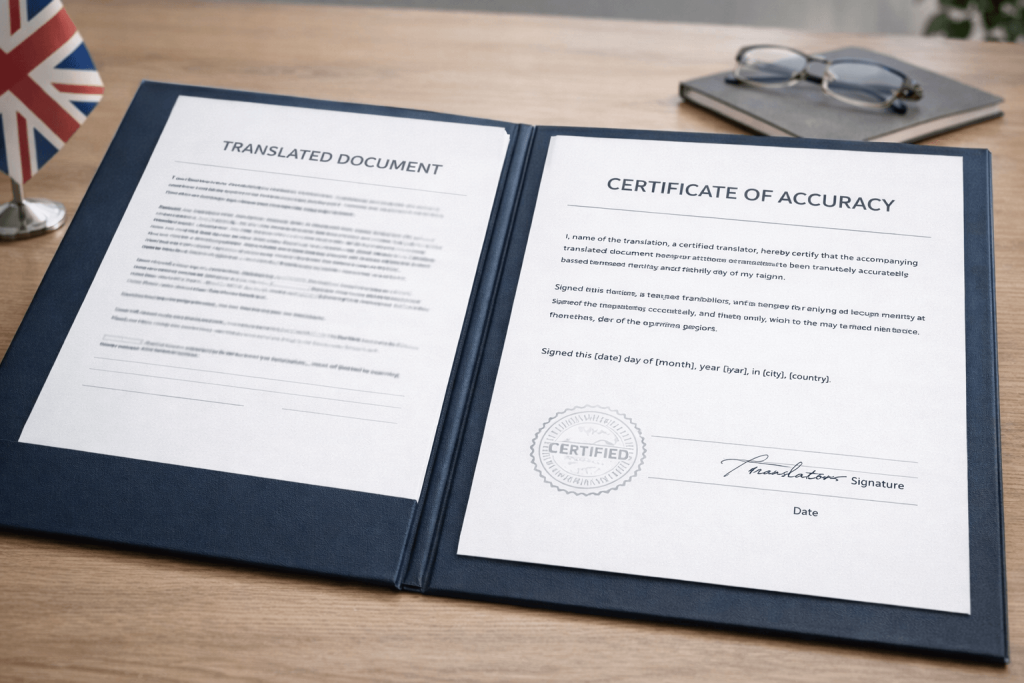
A certified translation typically includes:
The translated document (formatted appropriately)
A signed certificate of accuracy
The date and translator/company details
A signature and stamp/seal where required
If your document is for UK authorities, universities, courts, or regulated bodies, certified translation is the safer choice: Certified Translation Services
Avoid artificial urgency — if it’s not truly urgent, don’t pay urgent pricing
Red flags: when “cheap translation” becomes risky
Be cautious if a provider:
Won’t confirm who translated the document
Avoids explaining what “certified” includes
Can’t support the formatting your institution expects
Promises “instant” human translation for complex documents
Doesn’t offer a clear way to correct issues if an authority asks questions
For official submissions, the cost of a rejected application can be much higher than the cost difference between providers.
How much does the NHS spend on translation services?
People often ask “how much does the NHS spend on translation services” because it highlights how essential language access is in healthcare.
A helpful way to understand it:
Interpreting (phone/video/in-person) is a major driver of cost because it needs staffing and availability, not just word count.
Written translation supports letters, patient info, consent forms, and public communications.
Costs vary significantly by region, language needs, and whether British Sign Language is included.
Public frameworks and procurement arrangements are designed to ensure coverage, quality, and patient safety — so the headline figure you see in the news is not always the same thing as actual yearly spend.
Frequently asked questions
How much are translation services for a one-page document?
For personal documents (like certificates), pricing is often per page/document rather than per word. The price changes based on language pair, formatting, and whether certification is required for official use.
What is the average cost for translation services?
Most projects fall into predictable bands once you know: language pair, word count, complexity, deadline, and whether you need certified translation. The fastest way to get a reliable number is a file-based quote.
What is the going rate for translation services?
The going rate varies widely. General text is typically priced lower than specialist legal, medical, or technical work. Urgent delivery and formatting needs also push the rate up.
How much for translation services if I need it urgently?
Urgent work usually costs more because it requires priority resourcing and tighter QA timelines. If you can extend the deadline even slightly, ask for a standard option to compare.
How much do certified translation services cost in the UK?
Certified translations are usually priced per page/document because certification and formatting are part of what you’re buying. If your documents are for UKVI/Home Office or official bodies, certified translation is the safest option.
How much is a translation service for my language pair?
Language availability matters. Some pairs are more common and may be more cost-effective; rarer pairs may cost more due to specialist availability. Check supported languages here: https://locatetranslate.co.uk/languages/
If you’ve ever had to use a document outside the country it was issued in—or communicate with customers, patients, investors, or regulators in another language—you’ve already met the answer to who needs translation services: people and organizations who can’t afford misunderstanding.
Translation matters because it sits in the “high-stakes middle” between what you meant and what the reader must accept—a government office, a court, a bank, a hospital, a client, or an international audience.
A quick, practical definition
Translation services convert written content from one language to another with the goal of preserving meaning, accuracy, and intent. Depending on where the translation will be used, you may also need:
Localization (adapting content for a specific market/culture)
If you’re not sure which level you need, the fastest way to get clarity is to share the document and where it will be used. You can do that here:upload your document for a quote.
Who uses translation services?
People often think “big companies.” In reality, who uses translation services includes:
Individuals
Visa and immigration applicants
People getting married abroad / registering a marriage at home
Students applying to universities or professional bodies
Patients and families sharing medical history across borders
Workers relocating for employment (or bringing dependents)
Anyone handling legal matters in a non-native language
Businesses (from startups to multinationals)
Companies selling online to international customers
Firms entering a new market (web, product, support, compliance)
Employers onboarding or training multilingual staff
Organizations managing cross-border contracts and disputes
Finance teams reporting to global stakeholders
Public bodies & nonprofits
Courts, legal aid, and support services
Healthcare providers and research organizations
NGOs delivering programs across languages
A simple test: do you need professional translation?
If you answer “yes” to any of these, you likely need a professional service:
Will the translation be used for an official purpose? (visa, court, bank, university, regulatory body)
Would an error cause rejection, delays, or legal/financial risk?
Does the document contain specialist terminology? (legal, medical, financial, technical)
Is the content customer-facing and brand-sensitive? (website, ads, product pages, reviews, emails)
Do you need the formatting preserved exactly? (stamps, tables, certificates, PDFs)
When the risk is real, translation stops being a “nice-to-have” and becomes part of getting the outcome you want.
If you’re wondering which companies need translation services, the most common answer is: companies that touch regulated systems, sensitive outcomes, or international customers.
Companies that almost always need translation
Legal & compliance-led businesses: law firms, compliance consultancies, HR and employment services
That’s why translation isn’t just about language—it’s operational.
Which industries need translation services (and what they translate)
Below are the industries most often linked to translation needs—with the “why it matters” behind each. This is where many generic articles stop at a list; this guide goes deeper so you can identify the right service level.
Legal and immigration
Legal translation is unforgiving: one ambiguous phrase can change obligations, rights, or outcomes.
Common documents:
Contracts, agreements, terms and conditions
Court documents, witness statements, judgments
Powers of attorney, affidavits, declarations
Immigration packs, supporting evidence, personal documents
Why it matters:
A mistranslation can cause rejections, delays, disputes, or unenforceable terms
Many legal documents require formal presentation (and sometimes certification)
International education and hiring often rely on documents being accepted quickly and clearly.
Common documents:
Diplomas, transcripts, certificates
Letters of recommendation and statements
Training materials and internal policies
Employment contracts and compliance documents
Why it matters:
Institutions need clarity and consistency
Incorrect translation can delay admissions, onboarding, or credential checks
For credential-related submissions, you may also need specific formats depending on where you’re applying. If your documents are for UK recognition, see:NARIC / UK ENIC translation.
Technology, apps, and product teams
Tech translation goes beyond words: it must preserve usability.
Common documents:
Apps, onboarding flows, product UI strings
Help centres and support documentation
Release notes and technical guides
Policies, terms, privacy notices
Why it matters:
Poor translation increases churn and support tickets
Consistency across UI is critical
Localization prevents cultural misfires and confusion
People and organizations dealing with official processes (immigration, legal matters, finance, healthcare, education) and businesses operating across languages. The common thread is that errors cause rejection, risk, or lost revenue.
Who uses translation services in everyday life?
Individuals often use translation for certificates, bank statements, academic documents, medical reports, and legal paperwork—especially when submitting documents internationally or to official bodies.
Which industries need translation services the most?
Legal, healthcare, finance, education, technology, manufacturing, and e-commerce rely heavily on translation because accuracy affects safety, compliance, decisions, and customer trust.
Who needs financial translation services?
Banks, investors, multinational companies, accountants, auditors, and anyone submitting or reviewing financial statements, revenue reports, corporate finance documents, or financial analysis across borders.
Why are translation services important for businesses?
They protect brand trust, reduce misunderstandings, enable international growth, and ensure key documents (contracts, policies, financials, customer content) are understood and accepted as intended.
How do I know if I need a certified translation?
If the translation is for an official purpose (visa, court, university, bank, government body), you may need certification. The quickest way to confirm is to share the document and where it will be used:upload your document for guidance.
If you’ve searched how to become a certified Spanish translator, you’ve probably noticed something confusing: the word certified can mean two different things, depending on where you live and what kind of work you want.
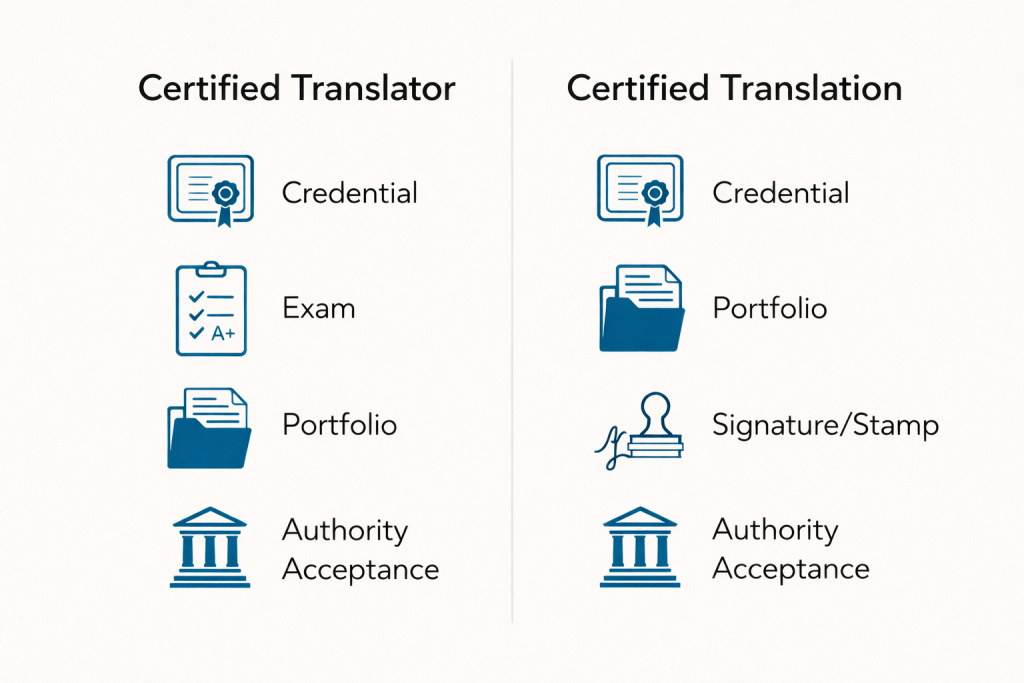
Sometimes it means you hold a professional credential (like an exam-based certification or a recognised qualification).
Sometimes it means your translation is “certified” (signed, stamped, and accepted by an authority for official use).
This guide clears up that confusion and gives you a practical roadmap—whether you want to translate English ↔ Spanish, English ↔ Arabic, or you’re also exploring other languages (including Korean).
The Fast Answer: Your Best Route Depends on Your Goal
Before you spend money on courses or exams, decide which of these you’re aiming for:
1) Career credential (you become a “certified translator”)
You’re building proof of competence for employers, agencies, courts, or specialist clients. This typically involves:
a qualification and/or exam,
a professional membership pathway,
a credible portfolio and domain experience.
2) Official document work (you produce “certified translations”)
You’re delivering translations for:
immigration and visas,
courts and solicitors,
universities,
passports, civil records, and official submissions.
In the UK, official acceptance usually depends on the certification statement and who provides it (qualified translator or accredited agency), plus any additional steps like notarisation or apostille—depending on the receiving authority.
If you want to understand how certification works for official documents in the UK, see:
Key Definitions (So You Don’t Train for the Wrong Thing)
Certified translator vs certified translation
Certified translator: You hold a recognised credential or qualification (varies by country and sector).
Certified translation: A translation delivered with a signed declaration of accuracy (often stamped), intended for official use.
Translator vs interpreter
Translator: works with written text.
Interpreter: works with spoken language (court, medical, phone/video interpreting). These have different certification routes and exams in many countries.
How to Become a Certified Spanish Translator: The Step-by-Step Roadmap
This is the most reliable path if you want clients and agencies to take you seriously (and to win higher-value work).
Step 1: Choose your direction (this matters more than people think)
Most professional translators specialise in one direction:
Spanish → English (common for UK/US markets)
English → Spanish (common for Spanish-language markets)
If you try to market both directions too early, your quality proof becomes harder. Pick your strongest direction first, then expand once you’ve built evidence.
Step 2: Get to “professional writing level” in your target language
Being fluent isn’t enough—your target language must read like it was originally written that way.
A simple test:
Can you write a one-page formal letter, legal-style paragraph, and a neutral press release in your target language without sounding translated?
If not, focus on writing practice alongside translation.
Step 3: Pick a specialism (it accelerates credibility)
Generalists struggle to stand out. Specialists get hired faster.
High-demand Spanish/English niches include:
immigration and civil documents (birth, marriage, police certificates),
legal contracts and litigation support,
medical and patient documents,
business and compliance (KYC/AML, policies, reports),
marketing and brand localisation.
If you’re drawn to legal work, explore legal translation services in London to see what real-world legal translation includes (terminology, formatting, confidentiality, consistency).
Step 4: Build formal proof (choose one “anchor credential”)
If your goal is career certification, you need one strong proof point that signals competence.
Depending on your country/market, this might be:
a recognised translation qualification,
an exam-based certification,
a professional membership pathway (plus evidence of work),
a licensing route for legal translators in certain jurisdictions.
You don’t need everything. You need one anchor plus a strong portfolio.
Step 5: Create a portfolio that looks “agency-ready”
Most candidates fail here. Your portfolio should prove:
accuracy,
consistency,
formatting skill,
professionalism and confidentiality awareness.
Build a 6-piece portfolio (best-in-class format):
Civil document (certificate-style formatting)
Legal clause + definitions (clean, consistent)
Medical report excerpt (neutral tone, careful terminology)
Business policy page (formal register, clarity)
Short marketing copy (tone + localisation)
A “revision sample” (show how you improved a flawed translation)
Tip: Keep personal data removed and use realistic templates.
If you want to see the types of Spanish document jobs clients actually request, browse:
How to Get Certified as a Spanish Translator (UK vs Global Reality)
If you’re in the UK (or targeting UK clients), the practical reality is:
Many clients care most about whether your work is accepted by the authority (Home Office, court, university, etc.).
Professional bodies and recognised qualifications strengthen your profile, but official acceptance often comes down to proper certification and credibility.
How to Become a Certified English–Spanish Translator (Direction, Proof, and Market Fit)
If your query is how to become a certified English Spanish translator, here’s the shortcut:
Pick your direction: English → Spanish or Spanish → English
Choose your market: official documents, legal, medical, business
Build one anchor credential + 6-piece portfolio
Learn official certification packaging (for document acceptance)
Apply to agencies and build domain experience
You become “certified” in the real market when:
your work gets accepted,
you’re trusted by repeat clients,
your proof (credential + portfolio) makes hiring you a low-risk decision.
How to Become a Certified Korean Translator (Same Strategy, Different Evidence)
People searching how to become a certified Korean translator usually face the same confusion: credential vs certified translation.
The core strategy is the same:
one direction first,
one niche,
one anchor credential,
portfolio + QA workflow,
authority-ready formatting for official documents.
If you want to understand what Korean official document work often involves (formatting, accuracy expectations, turnaround), see: Korean translation services
The “Certification Stack”: What Makes You Hireable (and Link-Worthy)
High-performing translators are built on a stack, not a single certificate.
1) Proof of competence
recognised qualification or exam route (where relevant),
visible portfolio,
domain expertise.
2) Proof of reliability
deadlines met,
clean communication,
consistent formatting,
confidentiality awareness.
3) Proof of acceptance
certified translations delivered in the format authorities accept,
How do I become a certified Spanish translator in the UK?
Most people build credibility through a recognised qualification and professional experience, then focus on delivering certified translations in the format UK authorities accept. For official document acceptance, certification statements and proper formatting matter as much as credentials.
How to get certified as a Spanish translator if I’m targeting the US market?
In the US, many translators pursue an exam-based certification route and build a portfolio for agencies and direct clients. Requirements vary by sector (legal, medical, court work), so choose your target market first.
How to become a certified Arabic translator for legal or official documents?
Arabic official work often demands strict accuracy in names, dates, register, and transliteration. Build one direction, one niche, a strong portfolio, and master the certification package required for official acceptance in your target country.
How to become a certified English Spanish translator if I want to offer both directions?
Start with your strongest direction first, prove quality with an anchor credential and portfolio, and expand to the second direction only once you can maintain professional writing level and consistent quality.
How to become a certified Korean translator?
The pathway is similar: choose direction, specialise, build proof (credential + portfolio), and learn authority-ready formatting for official documents. Clients care most about accuracy, consistency, and acceptance.
Do I need to be “certified” to provide certified translations?
It depends on the country and the receiving authority. In many cases, what matters is that the translation is certified correctly (with a declaration of accuracy and required details) and produced by a credible provider.
If you’re searching for how to become a certified legal translator, you’re likely in one of two situations: you want a clear professional pathway into high-stakes translation, or you need to understand what “certified” really means before you invest time and money. This guide covers both—step by step—so you can build real credibility in legal translation and expand into medical translation with confidence.
Along the way, you’ll get practical checklists, real-world examples, and a simple “proof of competence” system you can use to win your first serious clients (or get approved by agencies).
What “certified” means in legal and medical translation
“Certified” can mean different things depending on the country and the purpose of the translation. Before you chase a certificate, clarify what the market actually requires.
The 3 most common meanings of “certified”
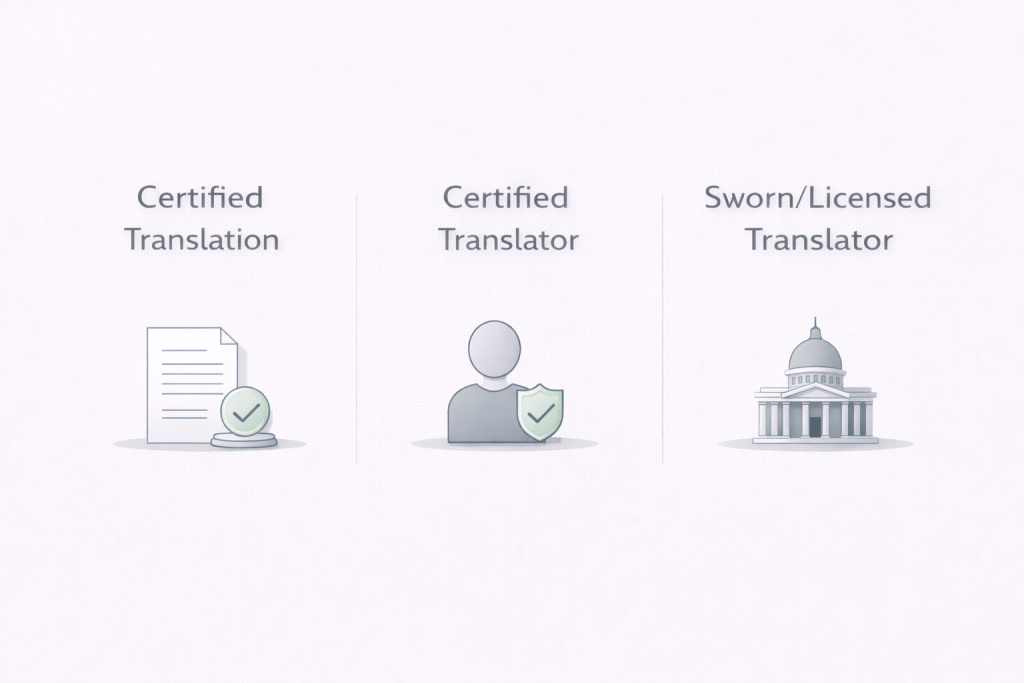
Certified translation (document certification) A translation delivered with a signed statement attesting it’s a true and accurate translation, typically used for official submissions (immigration, courts, councils, universities).
Certified translator (credentialed professional) A translator who holds recognized credentials (exam-based certification, professional membership grade, degree-level qualification, or recognized specialist training).
Sworn / officially licensed translator (jurisdiction-based) In some countries, legal translations must be completed by translators who are officially appointed, registered, or licensed by a government body or court.
Legal vs medical: why “certified” matters more than you think
Both legal and medical translation share one reality: small errors can cause big consequences—rejections, delays, disputes, misinterpretation, or risk to a person’s rights or health. That’s why clients don’t just buy language skills; they buy risk reduction.
If you want to work in these fields, your goal is to make your competence easy to verify.
The fastest pathway: become “certification-ready” before you become “certified”
Here’s an uncomfortable truth: many translators chase credentials too early and still struggle to get work—because they can’t demonstrate real-world reliability.
So your roadmap should run like this:
Competence → Proof → Credential → Consistent Work
What “proof” looks like (even before a certificate)
You can build a credible proof bundle in 30–60 days:
A focused legal or medical glossary you created (with sources and usage notes)
3–5 portfolio samples (anonymized and permission-safe)
A documented quality workflow (revision + checks)
A confidentiality and secure-handling statement
A specialization statement (what you translate, what you don’t)
This bundle will help you:
pass entry screening with agencies,
justify higher rates,
and avoid low-value work that damages your positioning.
Step-by-step: How to become a certified legal translator
Step 1: Choose a legal lane (don’t translate “everything”)#
Legal translation is not one category—it’s multiple sub-fields, each with its own terminology and document logic.
Ambiguity control: do not “fix” unclear source text—flag it
The skill that upgrades you instantly: knowing when to ask a clarification question, and how to document it professionally.
Step 5: Get a credential that matches your market
There isn’t one universal “legal translator certificate” that works everywhere. Instead, choose credentials that clients and agencies recognize in your target market:
degree-level translation qualifications,
professional-body membership grades,
exam-based certifications,
specialist legal translation training from reputable providers.
If your work will be used for official submissions, you should also understand how certified document translations are produced and presented. This guide helps: Do you need a certified translation?
Step 6: Build a portfolio that agencies will actually accept
A legal translation portfolio must look like a real job, not a classroom exercise.
Create 3–5 sample packs such as:
a short contract section (definitions + obligations)
a “letter before action” style letter
a court form + supporting statement (short)
a certificate-style document with stamps and formatting
Make it professional:
include a clean cover page,
include a short “translation brief” (who it’s for, purpose, jurisdiction),
Many legal translation jobs are “certified translation” jobs—meaning the client needs a signed certification statement and a properly formatted deliverable.
If you want to see how certified translations are typically requested and handled, compare:
If you’re hiring a legal translator (or want to sound like a pro when clients ask): Ask about quality checks, confidentiality, revision process, and whether the translation will be accepted by the receiving authority.
How to become a certified medical translator (and why it’s different)
Now let’s cover the second keyword set: how to become a certified medical translator and how to get certified as a medical translator.
Medical translation has a different risk profile:
terminology is dense,
errors can have patient safety consequences,
and many documents require extreme precision in dosage, timing, and clinical meaning.
Step 1: Choose a medical domain (don’t translate “all medicine”)
Step 2: Build a medical terminology system (not just vocabulary)
Medical translation is about controlled language.
Your terminology system should include:
abbreviations (and region-specific differences),
measurement units and formatting,
medication names (brand vs generic),
anatomical terms (Latin/Greek consistency),
lab reference ranges and reporting conventions.
Safety rule: if you’re unsure, you don’t guess—you verify.
Step 3: Know what you must never do
In medical translation, a professional boundary matters:
do not add clinical advice,
do not “correct” diagnoses,
do not normalize unclear or inconsistent source text,
do not change units or dosing logic,
do not remove warnings or contraindications language.
Your job is accuracy and clarity—within the scope of translation.
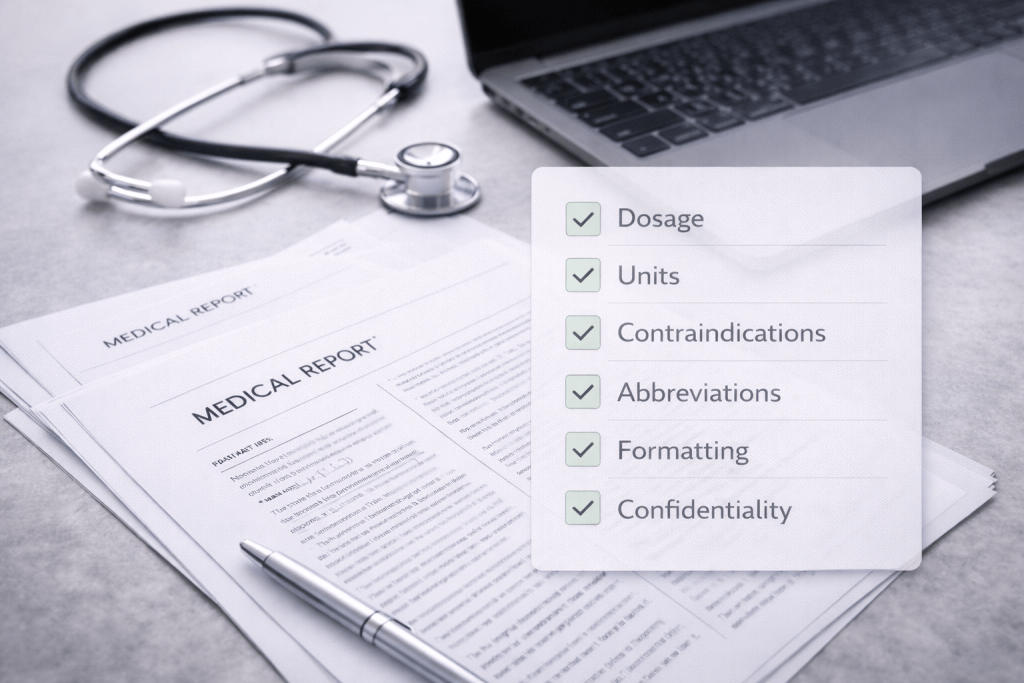
Step 4: Create a medical QA checklist (the one clients never see—but trust)
Use this every time:
dosage & units double-check (mg, mcg, ml, mmol/L, etc.)
timing & frequency consistency (OD, BID, TID, “as needed”)
contraindications preserved exactly
patient identifiers handled securely
abbreviations expanded only when appropriate
formatting preserved (tables, charts, headings)
Step 5: Get a medical-specific credential or training
Medical translation credibility is often built through:
specialist medical translation courses,
demonstrable experience,
professional membership recognition,
and a tight portfolio.
If you do interpretation as well: medical interpreting certifications and medical translation are not the same track. Many professionals do both, but they’re assessed differently.
The “Evidence Pack” that makes you instantly more hireable
Whether you’re going legal or medical, create this pack and you’ll stand out from 90% of beginners.
Your Evidence Pack (copy/paste checklist)
Specialization statement (what you translate + what you don’t)
Common mistakes that block translators from getting certified work
Trying to specialize in legal + medical + marketing at once
No proof (no portfolio, no glossary, no QA process)
Overconfidence with terminology (guessing instead of verifying)
Ignoring formatting (especially in legal docs)
No boundaries (accepting documents beyond competence)
Weak client briefing (not clarifying purpose, jurisdiction, or required format)
If you’re hiring a certified legal or medical translator: a quick safety checklist
This section helps you position yourself professionally because it mirrors how serious clients think.
Ask:
What’s the document for (authority, court, hospital, university)?
Is a signed certification statement required?
Will the translator preserve formatting exactly?
Is there a revision step by a second linguist?
How is confidential data handled?
Will names, numbers, and dates be double-checked?
For official submissions, many clients simply choose a reliable agency to avoid rejections and delays. If that’s you, start here: Certified translations.
Frequently Asked Questions
1) How to become a certified legal translator if I don’t have a degree?
You can start by building a legal specialization lane, creating a proof-based portfolio, and completing recognized training or a credential aligned to your market. Many agencies assess real competence first: terminology control, formatting accuracy, and a reliable QA process.
2) How long does it take to become a certified legal translator?
If you already translate professionally, you can become certification-ready in 60–90 days with focused practice and a strong Evidence Pack. Formal credentials can take longer depending on the program or exam schedule.
3) How to become a certified medical translator with no medical background?
Start with patient-facing document types, build a controlled terminology system, and complete specialist medical translation training. Medical work requires strict safety checks, so grow your scope gradually and avoid high-risk texts until you’re fully competent.
4) How to get certified as a medical translator—what credentials matter most?
Credentials vary by country and client type. Generally, specialist medical translation training, recognized professional credentials, and a demonstrable portfolio matter most. For some roles, medical interpreting certifications exist too, but they are a separate track from translation.
5) What’s the difference between a certified translation and a certified translator?
A certified translation is a specific deliverable (often with a signed certification statement). A certified translator is a person with recognized credentials. You can sometimes provide certified translations without being “certified” by an exam body, depending on jurisdiction and purpose.
6) Can I use AI tools to translate legal or medical documents?
AI can help with terminology research and drafting support, but you must not rely on it blindly for legal or medical content. These fields require controlled terminology, formatting accuracy, and human verification—especially for names, numbers, dosage, and legal meaning.
If you’ve Googled “how to become a certified translator in Canada,” you’ve probably noticed something confusing right away: the word “certified” doesn’t mean the same thing everywhere.
In Canada, it usually means a protected professional title granted through a provincial association pathway (often involving peer assessment). In the US, people often mean ATA-certified translator (translation) or state/federal court interpreter (interpreting). In Germany, “certified” frequently means court-sworn/appointed. In the UK, “certified translation” is typically about how a translation is presented for official use rather than a government-issued “translator licence.”
This guide clears the fog with practical steps, country-by-country routes, and the exact checkpoints you’ll need—especially if you’re targeting Canada first.
Certified, sworn, court-approved: a quick glossary (so you don’t take the wrong path)
Certified translator (Canada – professional title): A translator recognized by peers through a provincial certification route (commonly exam or dossier-based), allowing you to use “Certified Translator” in that jurisdiction.
ATA-certified translator (US – credential): A translation credential earned by passing the ATA certification exam in a specific language pair. It’s widely respected in the US market.
Court-certified interpreter (US – interpreting credential): A credential for spoken interpreting in courts. This is not translation, and requirements vary by state/federal system.
Sworn / court-appointed translator (many European countries): A translator who is officially authorized/appointed (often by a court) to produce translations accepted as “official” without additional steps.
Certified translation (UK/Ireland/NZ – a document format): A translation delivered with a signed statement, date, contact details, and sometimes stamping—so authorities can trust the translation as a faithful rendition.
Start here: the “right route” decision tree (90 seconds)
Choose the route that matches your goal:
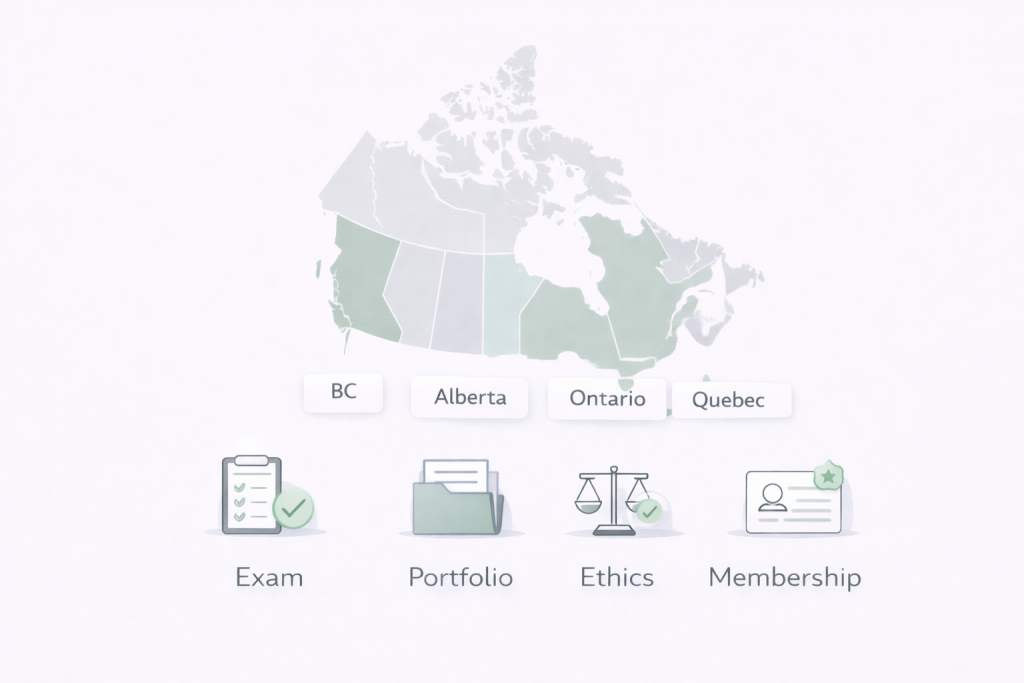
You want the protected title “Certified Translator” in Canada → Follow the provincial association route (exam or dossier). Start with Ontario/Alberta/BC/Quebec rules below.
You want US credibility as a translator (not an interpreter) → Consider ATA certification + strong specialization portfolio.
You want to work in courts (spoken language) → You likely need court interpreter certification (state or federal).
You need official translations accepted abroad (Germany/France/Spain/Italy, etc.) → You’ll need a sworn/court-appointed translator (or a service that can provide one).
You’re not sure yet and just want paid work fast → Build a portfolio, pick a niche, work with agencies, and then pursue credentials once you know your best language pair + market.
Canada: how to become a certified translator (the step-by-step that actually works)
In Canada, certification is provincial/territorial. That means your pathway starts with the association that governs or manages professional recognition in the province where you plan to practise or present yourself as certified.
Step 1: Pick your province (because the rules are not identical)
Ask yourself:
Where will most of your clients be?
Where do you intend to market yourself as “certified”?
Do you plan to work with government, courts, or regulated institutions?
If you’re unsure, start where you live (or where you’ll build the most client relationships) and expand later through recognized mobility/affiliation pathways.
Step 2: Confirm your language direction and specialization
Most serious certification routes assume you can produce publication-quality writing in your target language, not just “good bilingual ability.”
Pick:
Language pair and direction (e.g., French → English, Arabic → English, English → Spanish)
You’ll progress faster if you choose one strong direction and one primary domain.
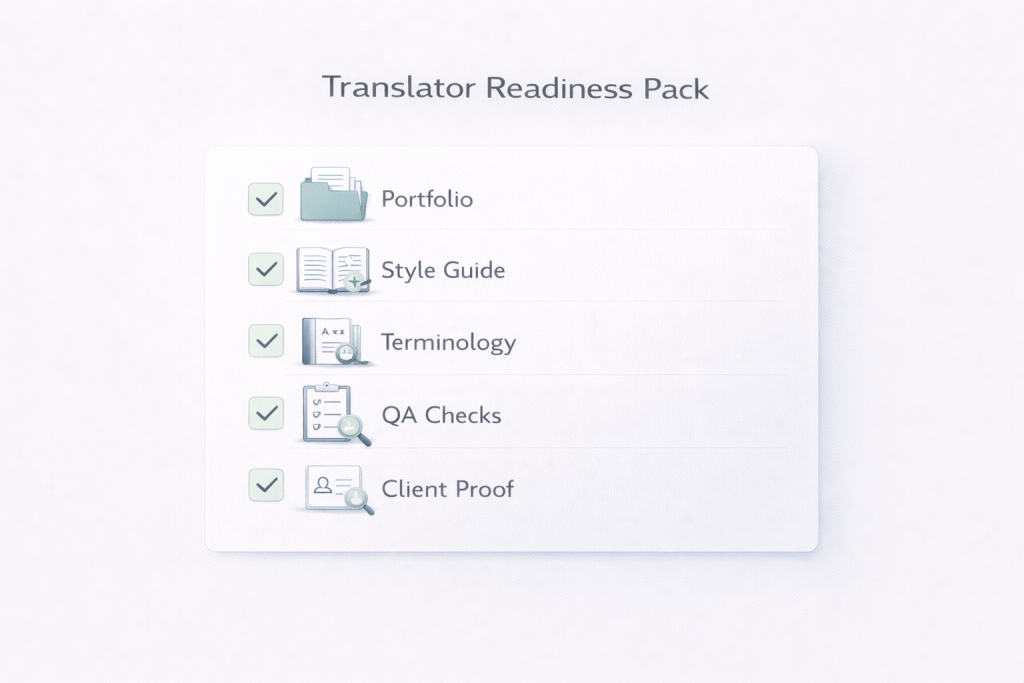
Step 3: Build your “proof of readiness” pack (before you apply anywhere)
This is the single biggest difference between applicants who succeed quickly and those who stall.
Prepare:
A translation-focused CV (not a general résumé)
6–10 portfolio samples (with brief context, not confidential client details)
A list of reference materials you actually use (dictionaries, corpora, style guides)
A short summary of your domain expertise (e.g., legal/immigration document types you know)
Step 4: Join the provincial association pathway
Most provinces run certification through a professional body that may require:
Membership as a student/associate/candidate category first
Proof of education, experience, or both
Ethics or admission requirements
Once you’re inside the pathway, you’ll usually qualify for one of two routes:
Certification by exam (common; peer-assessed exam)
Certification on dossier / portfolio (available in some provinces for experienced translators who can demonstrate work at a high level)
Step 5: Choose your certification route (exam vs dossier) based on your profile
Choose the exam route if:
You have strong writing skills and can perform under time constraints
You want a clearer “pass/fail” milestone
You’re earlier in your career but ready to prove competence
Choose dossier/portfolio route if:
You have years of real professional work already
You can provide substantial, high-quality evidence
You want an evaluation based on consistent performance over time
Step 6: Train like it’s a professional performance, not a language test
Certification assessment typically rewards:
Accuracy + completeness
Idiomatic target-language writing
Terminology consistency
Professional judgement (register, tone, formatting)
Error avoidance (names, dates, numbers, official terminology)
A smart prep plan:
Do timed translations weekly
Have a qualified reviewer mark your work (errors categorized)
Build a personal error log (your recurring mistakes are your syllabus)
Step 7: Maintain professional standing once certified
Certification is not “set and forget.” Expect:
Ongoing professional conduct obligations
Continuing professional development expectations
Clear rules on how you present your credential publicly
How to become a certified translator in Ontario (ATIO)
If you’re searching how to become a certified translator in Ontario, your first checkpoint is understanding that Ontario’s pathway is managed through the province’s professional association route.
Practical steps:
Apply for the appropriate membership category aligned with certification candidacy
Select your direction (e.g., French → English) and confirm you can write at a professional level in the target language
Choose your route: certification exam or dossier-based evaluation (where applicable)
Prepare with real-world texts (legal/administrative style often appears)
Pass the assessment and follow the professional obligations once recognized
A reality check: people often underestimate how much the assessment is about excellent target-language writing, not just bilingual comprehension.
How to become a certified translator in Alberta (ATIA)
If you’re searching how to become a certified translator in Alberta, expect a structured route with prerequisite checks and professional expectations.
Practical steps:
Enter the association pathway and complete any required prerequisite exams (ethics/proficiency requirements may apply)
Build a portfolio that demonstrates real professional competence
Choose exam or dossier-based certification, depending on eligibility
Prepare for assessment with timed practice and professional review
Once recognized, stay compliant with professional conduct expectations
If your strongest language is not English, invest early in target-language writing polish—this is where many candidates lose marks.
How to become a certified translator in British Columbia (STIBC)
If you’re searching how to become a certified translator in BC, the process typically involves:
Membership pathway entry
Meeting eligibility requirements
Sitting a recognized certification exam route (often administered through provincial structures)
Maintaining good standing and professional conduct
BC is competitive—your portfolio and professional positioning matter as much as your credential.
How to become a certified translator in Quebec (OTTIAQ)
If you’re searching how to become a certified translator in Quebec, you’ll find Quebec has its own structure and terminology, and degree equivalency may play a larger role.
Practical steps:
Confirm whether your degree/training is recognized (or submit for equivalency assessment)
Apply through the professional order’s pathway
Provide the required documentation and professional evidence
Complete the necessary evaluation route for the designation
Maintain professional standing and obligations
If you trained outside Canada, start early—document evaluation can add time.
Canada “fast track” strategy (for people who want results in 6–12 months)
If you want the most efficient path toward certification readiness, focus on three levers:
1) Pick one language direction and one domain
A strong French→English legal translator will outpace a “generalist in five language directions” almost every time.
2) Build a portfolio that looks like real client work
Include:
Vital records translations (birth/marriage certificates)
Completing the credentialing steps set by the state body
For written translation, again: ATA + portfolio is the most portable.
How to become a certified translator in Michigan
Michigan offers a structured court interpreter certification/testing route. If your goal is court work, follow that system.
If your goal is translation, don’t accidentally train for interpreting exams—choose translation-specific development instead.
How to become a certified translator in NY
New York’s court interpreter process includes written exam requirements and additional steps depending on the role/type of appointment.
If your market is legal translation in New York (documents, contracts, immigration), ATA + strong legal portfolio often matters more than an interpreting credential.
How to become a certified translator in Texas
Texas uses a licensing framework for court interpreters with written and oral exams, plus administrative requirements.
For translators, build credentials and proof around translation output quality and domain expertise.
United Kingdom: how to become certified translator UK (and what “sworn translator UK” really means)
Many people search:
how to become certified translator UK
how to become a sworn translator UK
how to become sworn translator in UK
Here’s the key point: the UK generally doesn’t use a “sworn translator” system in the same way Germany, France, Spain, or Italy do. For most UK official purposes, what matters is that the translation is properly certified as a document and produced by a competent professional.
A practical UK pathway (for professional credibility)
Build formal training (degree, postgraduate study, or equivalent professional development)
Consider respected professional exams such as high-level translation diplomas
Join a professional body at the right membership level as your experience grows
Build a portfolio focused on official document types and one or two domains
Learn the correct UK-format certification statement for official submissions
It matters when your translation is destined for a country that requires sworn/court-appointed translators. In that case, you don’t “become sworn in the UK”—you need the translation completed by an officially appointed translator in the destination country.
Germany: how to become a certified translator in Germany (sworn/court-appointed route)
If you’re searching how to become a certified translator in Germany, you’re usually referring to the pathway to become publicly appointed/authorized and sworn (the translator whose work is accepted as official for authorities, courts, and notaries).
A practical high-level route:
Achieve verified professional competence (education, exams, recognized qualifications)
Apply to the competent authority/court in the German federal state where you will be appointed
Provide required documents (qualifications, language proof, clean record where required)
Complete the formal appointment/sworn process
Follow professional obligations and renewal rules as applicable
Germany is a “details matter” jurisdiction—requirements and responsible authorities can differ by federal state even under a more uniform framework. Plan for documentation, formalities, and precise compliance.
Ireland: how to become a certified translator in Ireland (and what official bodies usually expect)
Ireland commonly uses “certified translation” in the sense of a translation accompanied by a signed certification statement suitable for official use.
If your goal is to become professionally recognized:
Build formal education or demonstrate competence through professional assessment routes
Join a professional association pathway where relevant
If you work in legal/official contexts, follow the accepted certification format carefully
Build a portfolio around immigration, legal, and academic document categories
If your goal is certified translations for immigration/official submission, the “who can certify” rules are practical and specific—always follow the recipient authority’s instructions.
India: how to become a certified translator in India (what “certified” usually means)
India typically does not operate with one single, nationwide “certified translator licence” for all purposes. In many contexts, “certified translation” refers to a translation that is:
Produced by a competent translator/agency
Accompanied by a signed declaration/certification statement
Sometimes supported by notarization or affidavit depending on use case (embassy, visa, court, education)
Add formal training (translation studies, linguistics, legal/medical specialization)
Develop a portfolio with official document types (certificates, affidavits, legal statements)
Work with reputable agencies to accumulate verifiable experience
Learn the formatting and certification requirements used by your target recipients (embassies, universities, courts)
In India, credibility is often built through specialization + consistent quality + proper certification format rather than a single national credential.
New Zealand: how to become a certified translator in New Zealand (practical recognition route)
In New Zealand, professional recognition commonly centers around:
Formal training pathways
Professional association eligibility (where membership requires strict criteria)
Government or institutional testing routes for certain roles
A practical plan:
Obtain recognized training (or have overseas qualifications assessed)
Build experience with review and quality control
Align your professional standing to the roles you want (freelance, agency, government work)
Learn the certified translation format expected by the receiving authority
If your goal is official document translation work, make sure your process includes a proper certification statement, secure handling, and consistent formatting.
“Europe and beyond”: how to research any country’s certification system in 10 minutes
When you’re expanding internationally, don’t guess. Use this quick checklist:
1) Is the profession regulated?
Search: “official translator appointment” + country name If yes, the country likely has a sworn/court-appointed system.
2) Who is the end user?
Court?
Immigration authority?
University?
Notary? Each may have different acceptance standards.
Process discipline (terminology, QA checks, formatting)
Professional presentation (clear emails, deadlines, confidentiality)
The “professional QA routine” used by top translators
Before delivery:
Numbers, dates, names checked twice
Terminology list confirmed and consistent
Formatting matched to the source document
Final read-through in the target language only (to catch awkward phrasing)
If you need certified translations while you build your career
Many people pursuing certification also need certified translations for immigration, study, marriage, legal filings, or overseas submissions. When acceptance matters, the safest move is to use a service that delivers the correct format from day one.
Client note we hear often: “We were worried about rejection. The certified format and clear certificate statement made it straightforward.”
FAQs
1) How do I become a certified translator in Canada without a translation degree?
It depends on the province and route. Some pathways allow experienced translators to qualify through portfolio/dossier evaluation or by meeting eligibility requirements before attempting certification assessment. Your strongest leverage is a serious portfolio, verified experience, and professional-level target-language writing.
2) How to become a certified translator in Ontario if I’m internationally trained?
Start by aligning your documents (degree, transcripts if relevant, experience proof, portfolio samples) and applying through the Ontario professional pathway. Internationally trained applicants often need extra time for document verification and eligibility steps, so start early.
3) How to become a certified translator in Alberta as a beginner?
Begin by building competence and portfolio first, then enter the association pathway and complete required prerequisites. Certification assessment is designed for professional-level performance, so early-stage translators should plan for a structured ramp-up (training + review + timed practice).
4) How to become a certified translator in California—do I need ATA certification?
If you mean written translation, ATA certification is one of the strongest national credentials. If you mean court work, California’s court interpreter route is a different credential focused on spoken interpreting skills. Decide which job you actually want before committing time and money.
5) How to become certified translator UK or sworn translator UK?
Most UK “certified translation” needs are about the translation being properly certified as a document (signed statement, date, contact details, sometimes stamping). “Sworn translator” is usually a requirement in other countries (like Germany/France/Spain), not a standard UK licensing route.
6) How to become a certified translator in Germany?
Germany commonly requires a court-authorized/sworn route for official translations. The process involves proving competence and applying to the competent authority/court for appointment. Requirements can vary by federal state and role, so confirm the exact authority for your location and intended use case